
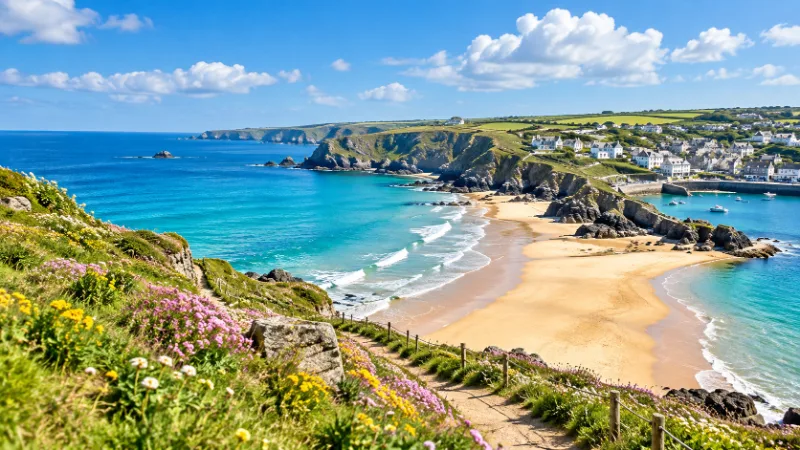
Cornwall is itself a county, so it is not located within another English county. It lies at the far southwestern end of England and forms part of the South West England region.
Cornwall shares its only land county boundary with Devon to the east, while sea surrounds much of the rest of the peninsula.
Cornwall is also a ceremonial county and, for local government purposes, most of mainland Cornwall is governed by Cornwall Council as a unitary authority.
Its strong Cornish identity, Celtic heritage and distinctive history sometimes lead to confusion about whether Cornwall is part of Devon or a separate country.
In modern geographical and administrative terms, however, the answer is clear. Cornwall is a county in South West England and forms part of England and the United Kingdom.
Where Is Cornwall Located in England?
Cornwall occupies the southwestern tip of England. Its long peninsula extends westwards into the Atlantic Ocean, giving the county an extensive coastline and making its location different from many inland English counties.
Devon lies immediately to the east. Much of the historic boundary between the two counties follows the River Tamar.
Cornwall contains a mixture of coastal communities, inland market towns and rural settlements.
Truro, Newquay, Falmouth, St Austell, Bodmin, Penzance, St Ives and Saltash are among the better-known settlements, while a wider range of Cornwall towns stretches from the Tamar Valley in the east to communities near Land’s End in the west.
Its position can be understood simply as:
- Country: England
- Region: South West England
- County: Cornwall
- Only Land County Neighbour: Devon
- Local Authority: Cornwall Council
Is Cornwall Part of Devon?
No. Cornwall is not part of Devon.
Cornwall and Devon are two separate counties within South West England. Devon sits immediately to the east of Cornwall, which is why the two are often mentioned together when discussing the southwest of the country.
The River Tamar forms much of the traditional boundary. Places on the Cornish side of the river belong to Cornwall, while areas immediately across the boundary are in Devon.
For example, Saltash is in Cornwall, while Plymouth, on the opposite side of the Tamar, is in Devon.
The neighbouring county has its own geographical identity, settlements and local government arrangements, as also reflected in the distinction between Devon and its surrounding counties.
Cornwall should therefore not be described as western Devon or as an administrative area within Devon.
Which County Borders Cornwall?
Devon is the only English county that shares a land boundary with Cornwall.
This is an important distinction because Cornwall is sometimes mistakenly described as bordering Somerset as well. It does not. Devon lies between Cornwall and Somerset.
Cornwall has only one landward direction in which it meets another county because it occupies a peninsula. Much of its northern, western and southern edges are coastline.
The River Tamar forms most of the Cornwall-Devon boundary. Cornwall Council’s Cornish-language history describes the Tamar as becoming an important territorial boundary during the reign of King Æthelstan in the 10th century.
This gives Cornwall a fairly simple geographical relationship with the rest of England compared with counties that share boundaries with several neighbouring areas.
Is Cornwall a Country or Part of England?
Cornwall is part of England. It is not a separate sovereign country.
However, Cornwall has a particularly strong regional and cultural identity, which helps explain why the question arises.
Cornwall has:
- Its Own Historic Celtic Language
- Distinctive Cornish Traditions
- A Recognisable Cornish Flag
- A Long Mining And Maritime History
- A Strong Sense Of Cornish Identity
- Historic Institutions Connected With Cornwall
The Cornish were formally recognised by the UK Government as a national minority under the Framework Convention for the Protection of National Minorities in 2014.
That recognition acknowledges Cornwall’s cultural and historic distinctiveness. It does not alter Cornwall’s constitutional position within England.
Someone can therefore correctly describe Cornwall as culturally distinctive while also recognising that, administratively and constitutionally, it remains part of England.
Is Cornwall Part of South West England?
Yes. Cornwall forms part of South West England, one of England’s official regions.
South West England covers a much larger area than Cornwall alone and includes counties and areas such as Devon, Dorset, Somerset, Gloucestershire and Wiltshire.
Cornwall occupies the westernmost part of the region. Its position on the peninsula means it is also one of the most geographically recognisable parts of a wider map of South West England.
The difference between the terms is important:
Cornwall is the county.
South West England is the wider English region containing Cornwall.
England is the country.
The United Kingdom is the sovereign state containing England, Scotland, Wales and Northern Ireland.
Cornwall and Devon are therefore neighbouring counties at the same geographical level rather than Cornwall being inside Devon.
What Is the History of Cornwall?
Cornwall’s history stretches back thousands of years and helps explain why the county developed such a distinct identity.
Prehistoric communities left numerous stone monuments, settlements, burial sites and other archaeological remains across Cornwall. The area later formed part of the Brittonic-speaking southwest of Britain.
After Roman rule ended in Britain, a Brittonic kingdom generally known as Dumnonia occupied much of what is now Cornwall and Devon. Cornwall’s population retained strong Celtic cultural and linguistic traditions as Anglo-Saxon political influence spread westwards.
Cornwall gradually became incorporated into the developing English kingdom during the early medieval period, although historians generally treat this as a process rather than an event that happened on one precise date.
Cornwall later became particularly important for tin production. The industry contributed to the development of distinctive institutions, including the Cornish stannaries that historically regulated parts of the tin-mining industry.
Another important development came in 1337, when Edward III created the Duchy of Cornwall for his son Edward, the Black Prince.
Mining expanded dramatically in later centuries. Cornwall became internationally associated with tin and copper, while Cornish miners and mining expertise travelled around the world.
Although mining declined, Cornwall’s industrial heritage remains a major part of its landscape and identity today.
When Did Cornwall Become Part of England?
There is no universally accepted single date on which Cornwall suddenly became part of England.
Instead, Cornwall’s incorporation into the developing English kingdom occurred gradually during the early medieval period as West Saxon political power expanded westwards.
One particularly important period was the reign of King Æthelstan from 924 to 939.
The year 936 AD is frequently associated with the establishment of the River Tamar as a boundary between Cornwall and the territory to its east.
However, treating 936 as the exact year that Cornwall simply “became English” would oversimplify a much longer historical process.
By the Norman period following the conquest of England in 1066, Cornwall was firmly integrated into the English political system.
Its incorporation did not remove its distinctive cultural identity. The Cornish language remained in use for centuries, while local traditions, mining institutions and geographical separation helped Cornwall retain characteristics that distinguished it from neighbouring counties.
When Did Cornwall’s Administrative Status Change?
Cornwall’s boundaries and historic identity are much older than its present local government structure.
Modern local government developed through several major reforms.
The Local Government Act 1888 established elected county councils across England, with Cornwall County Council taking responsibility for many county-level functions.
Another major restructuring came into effect in 1974 following the Local Government Act 1972. Cornwall continued to have a county council, while six district or borough councils operated beneath it.
These were:
- Caradon
- Carrick
- Kerrier
- North Cornwall
- Penwith
- Restormel
Under this arrangement, responsibilities were divided between Cornwall County Council and the six lower-tier authorities.
A further major change took place on 1 April 2009, when that two-tier structure was abolished across mainland Cornwall and replaced by Cornwall Council as a single unitary authority.
The 2009 reform changed local government administration. It did not create Cornwall as a county, since Cornwall’s county identity existed long before the modern council structure.
How Did Cornwall Become a Unitary Authority?
Cornwall became a unitary authority area on 1 April 2009.
The change combined Cornwall County Council and the six former district and borough councils into one principal local authority, Cornwall Council.
Before the reform, different council responsibilities were divided between the county and district levels. The unitary system brought most principal local government functions under one authority.
Cornwall Council is now responsible for services including areas such as:
- Planning
- Housing
- Adult Social Care
- Children’s Services
- Highways
- Waste And Recycling
- Libraries
- Local Transport
- Public Health
The number of Cornwall Council electoral divisions was subsequently reduced. Since the 2021 local elections, Cornwall Council has had 87 councillors representing 87 electoral divisions.
This is why older sources referring to 123 Cornwall councillors are no longer current.
Is Cornwall a Ceremonial County and a Unitary Authority?
Yes. Cornwall can be both a ceremonial county and a unitary authority area because the two terms describe different purposes.
A ceremonial county is an area used for purposes including the appointment of a Lord-Lieutenant.
A unitary authority relates to local government and the delivery of council tax services.
For everyday geographical purposes, referring to Cornwall simply as a county is entirely appropriate.
For more detailed administrative discussions, its position can be described as:
- Historic County: Cornwall
- Ceremonial County: Cornwall
- Unitary Authority: Cornwall
- English Region: South West England
- Country: England
The distinctions become important when comparing Cornwall with areas that still use separate county and district councils.
What Is the Difference Between Cornwall, Devon and South West England?
Cornwall, Devon and South West England do not mean the same thing.
| Place | Classification | Relationship To Cornwall |
| Cornwall | County | The county itself |
| Devon | County | Cornwall’s eastern neighbour |
| South West England | Region | Contains Cornwall and Devon |
| England | Country | Contains the South West region |
| United Kingdom | Sovereign State | Contains England |
The geographical hierarchy can therefore be represented as:
United Kingdom → England → South West England → Cornwall
Devon does not sit between South West England and Cornwall in this hierarchy. Cornwall and Devon are neighbouring counties located within the same wider region.
Are the Isles of Scilly Part of Cornwall?
The Isles of Scilly have a more complicated relationship with Cornwall.
Geographically, the islands lie around 28 miles off Land’s End and have close historic and cultural connections with Cornwall.
For local government purposes, however, the Council of the Isles of Scilly is separate from Cornwall Council. The islands are therefore not simply another district administered by Cornwall Council.
For certain ceremonial purposes, the position is different. The Lieutenancies Act 1997 treats the Isles of Scilly as part of Cornwall for the purposes of lieutenancy.
This means the answer depends on the context:
- Local Government: Separate from Cornwall Council
- Ceremonial Purposes: Treated with Cornwall for lieutenancy
- Geographical and Cultural Context: Closely associated with Cornwall
The distinction is useful because simply saying that the Isles of Scilly are either completely inside or completely outside Cornwall can be misleading.
What Is the Administrative Centre of Cornwall?
Truro is Cornwall’s principal administrative centre and its only city.
Cornwall Council has its main headquarters in Truro, while the city also serves as an important centre for business, retail, education and public services.
Truro received city status during the 19th century and is particularly recognisable for Truro Cathedral.
It is sometimes informally called the “capital of Cornwall”.
However, describing it as Cornwall’s administrative centre or principal city is more precise because English counties do not have capitals in the same constitutional sense as sovereign countries.
Cornwall does not have one overwhelmingly dominant urban centre. Instead, population and economic activity are spread among Truro and numerous other towns across the county.
What Is the Population of Cornwall?
At the 2021 Census, Cornwall had a population of approximately 570,300.
This represented an increase from roughly 532,300 recorded at the 2011 Census.
Cornwall’s population is distributed across numerous towns, coastal settlements, villages and rural communities rather than being concentrated in a single major city.

Some of the county’s better-known population centres include:
- Truro
- St Austell
- Falmouth
- Camborne
- Redruth
- Newquay
- Penzance
- Bodmin
- Saltash
Population figures found in older Cornwall articles can therefore differ significantly, particularly where they still rely on 2011 Census data.
Why Does Cornwall Have Such a Distinct Identity?
Cornwall’s identity comes from centuries of cultural, linguistic, geographical and economic development.
One of its strongest distinctive features is Kernewek, the Cornish language. Cornish belongs to the Celtic family of languages and is closely related historically to Breton and Welsh.
Geography also played an important role. Cornwall’s peninsular position and the River Tamar boundary contributed to a degree of separation from areas further east.
Other important parts of Cornish identity include:
- St Piran’s Flag: The black flag with a white cross is widely used as a symbol of Cornwall
- Cornish Language: Kernewek remains an important symbol of cultural heritage
- Mining Heritage: Tin and copper mining shaped communities across the county
- Maritime Traditions: Fishing, ports and coastal trade influenced generations of Cornish life
- St Piran’s Day: Celebrated on 5 March and associated with Cornwall’s patron saint
- Cornish Food: The Cornish pasty remains one of the county’s best-known food traditions
- Celtic Heritage: Cornwall retains cultural connections with other Celtic areas of Britain and Europe
Cornwall’s distinctive identity explains why its status occasionally causes confusion, but cultural distinctiveness and modern administrative status are separate issues. Cornwall remains a county within England.
Conclusion
Cornwall is not situated within Devon, Somerset or another county. Cornwall is itself a county in South West England, with Devon forming its only land county neighbour.
Its history is more complex than its modern geographical status. Cornwall developed from a distinctive Celtic-speaking region and became progressively incorporated into the English kingdom during the early medieval period.
The 10th century, particularly the reign of King Æthelstan, was important in establishing the Tamar as a lasting boundary.
Cornwall’s administration continued to evolve much later. The most recent major change occurred on 1 April 2009, when the former county and district council structure was replaced by Cornwall Council as a unitary authority.
Despite these administrative changes, Cornwall has retained a particularly strong cultural identity built around its language, history, mining heritage and geographical position.
FAQs
Is Cornwall in England or Wales?
Cornwall is in England, not Wales. It occupies the southwestern peninsula of England and forms part of the South West England region.
Is Cornwall Its Own County?
Yes. Cornwall is a county in its own right. It is not an administrative part of Devon or any other neighbouring English county.
Is Cornwall Next to Devon?
Yes. Devon lies directly east of Cornwall and is Cornwall’s only neighbouring English county by land. The River Tamar forms much of the historic boundary.
Does Cornwall Border Somerset?
No. Cornwall does not border Somerset. Devon lies between Cornwall and Somerset.
Is Truro the Capital of Cornwall?
Truro is sometimes informally called Cornwall’s capital, but describing it as Cornwall’s administrative centre and only city is more precise.
What Region Is Cornwall In?
Cornwall is in South West England. It occupies the far western end of the region and sits immediately west of Devon.