
Receiving an unexpected letter from PO Box 140, Normanton, WF6 1YA can be confusing, particularly when the correspondence refers to a bank account, loan, old debt, PPI complaint or information you do not immediately recognise.
The most useful public postcode evidence currently available identifies the address as:
H B O S Plc
PO Box 140
Normanton
WF6 1YA
WF6 1YA is classified as a large-user postcode, a type of postcode generally allocated to organisations receiving substantial volumes of mail. Public postcode records place it in the Normanton/Whitwood area of the Wakefield district in West Yorkshire.
HBOS plc is an active company and is a wholly owned subsidiary of Lloyds Bank plc. HBOS was formed from the merger of Halifax and Bank of Scotland and later became part of Lloyds Banking Group.
That gives the address a considerably stronger Lloyds/HBOS connection than simply saying that it “might” belong to a bank.
However, the address alone does not prove that a particular letter is genuine. Fraudsters can copy genuine company names, addresses, logos and FCA details. Equally, there is not strong enough evidence to claim that every letter using PO Box 140 comes directly from Lloyds Bank or concerns a debt.
Who Uses PO Box 140 Normanton WF6 1YA?
There is an important distinction between the organisation associated with the postcode and individual brands or companies people have reported receiving letters from.
Many competing pages blur those two things together. The available evidence is better understood like this:
| Company or brand | Evidence connecting it to PO Box 140 | What the evidence means |
| HBOS plc | Current public postcode data lists “H B O S Plc, PO Box 140, Normanton WF6 1YA” | Strongest current association found |
| Bank of Scotland | A MoneySavingExpert forum user reported receiving a Bank of Scotland tax-residency letter in August 2019 using the address | Historical recipient report, rather than official confirmation that every BoS letter uses it |
| Lloyds / Lloyds-related PPI correspondence | A 2013 MoneySavingExpert discussion reported a Lloyds PPI refund letter carrying PO Box 140 Normanton; another historical online report also associated the box with banking-group PPI paperwork | Historical reported use |
| Halifax | Halifax has longstanding corporate links to HBOS/Lloyds, but no sufficiently strong source was found directly tying the Halifax brand itself to this exact PO Box | Group connection only — not confirmed use |
| Scottish Widows | Scottish Widows is within Lloyds Banking Group, but this research found no sufficiently strong direct evidence connecting its correspondence to PO Box 140 | Group connection only — not confirmed use |
| Britannia Personal Lending | Some secondary articles associate this name with the address. Companies House shows, however, that Britannia Personal Lending Limited changed its name to BOS Personal Lending Ltd in September 2018 | Historical/secondary association; should not be presented as a current confirmed sender |
| Specific debt collection agencies or PPI claims handlers | No sufficiently reliable evidence was found identifying a particular DCA or claims-management company as an established user of this exact address | Should not be named as confirmed senders without stronger evidence |
The Bank of Scotland and Lloyds evidence comes primarily from historic recipient reports, so it should not be given the same evidential weight as the current postcode record linking the box to HBOS plc.
The Britannia point is particularly important. Companies House records show that Britannia Personal Lending Limited was an earlier name of the company now called BOS Personal Lending Ltd, with the name change taking effect in September 2018.
Articles presenting “Britannia Personal Lending” as though it were necessarily a current trading identity risk giving readers outdated information.
This Lloyds connection is not unique to Normanton. We have also examined another Lloyds Banking Group PO Box address used for centralised correspondence.
Is PO Box 140 Normanton Linked to Lloyds Banking Group?
There is a clear corporate connection.
Companies House identifies HBOS PLC, company number SC218813, as an active company. Its published corporate reporting describes HBOS plc as a wholly owned subsidiary of Lloyds Bank plc.
HBOS itself was created following the merger of Halifax and Bank of Scotland in 2001 and joined Lloyds Banking Group in 2009.
Therefore, describing PO Box 140 simply as a mysterious address “possibly connected with Lloyds” understates the evidence.
A more accurate conclusion is:
Public postcode data currently associates WF6 1YA with HBOS plc, and HBOS plc forms part of the Lloyds banking group structure.
That still does not mean a recipient should automatically trust the contents of a letter merely because “HBOS”, “Lloyds”, “Halifax” or “Bank of Scotland” appears on it.
Where Is PO Box 140 Normanton WF6 1YA?
WF6 1YA is a Normanton postal address within the Wakefield metropolitan district of West Yorkshire, with postcode data placing it around the Whitwood/Altofts area.
It is recorded as a large-user postcode rather than an ordinary residential postcode. Large-user postcodes are commonly allocated where a substantial volume of mail needs to be routed to one organisation.
This explains why searching the postcode on an ordinary map can be misleading.
A PO Box or large-user postcode does not necessarily identify the building where the final employee handling the letter sits. Mapping datasets can also place PO Boxes around a sorting or delivery location.
A map marker showing a nearby bank branch should therefore not be treated as proof that the branch owns or operates the PO Box.
There is also insufficient public evidence to state confidently that PO Box 140 is operated by a particular private scanning company, hybrid-mail provider or third-party debt processor.
The available data establishes the HBOS association much more clearly than it establishes the underlying mail-processing contractor.
Why Do Banks Use Centralised PO Boxes?
Large financial institutions process enormous quantities of correspondence relating to accounts, lending, complaints, identity checks, tax information, arrears and historic products.
A central PO Box allows incoming replies to be routed into a dedicated processing operation rather than to an individual high-street branch.
Consequently, receiving a letter from a Yorkshire PO Box does not by itself mean that:
- A debt collection agency is based there;
- A bank branch physically occupies that address;
- The debt has been sold;
- Court proceedings have started; or
- The letter is fraudulent.
The company named in the correspondence, the account details and the independently verified contact information matter considerably more than the PO Box.
What Does a Genuine Letter From PO Box 140 Look Like?
There is no single reference-number format that proves a PO Box 140 letter is genuine.
A legitimate financial letter would ordinarily give enough information for the recipient to establish why they are being contacted.
Depending on the type of correspondence, useful checks include the company or trading name, a customer or account reference, details of the relevant product, the amount claimed where money is involved, complaints information and an independently verifiable way of contacting the organisation.
If a debt collection company is involved, the correspondence should also make clear who the original creditor is, who currently owns or administers the account and what balance is being claimed.
If an FCA Firm Reference Number appears on the letter, do not assume the number proves authenticity. The FCA specifically warns that clone firms can copy genuine firms’ names, addresses and regulatory details.
Warning signs worth checking
Be especially cautious if a letter tells the recipient to act immediately and then asks for payment to unfamiliar bank details, a one-time password, full online-banking credentials, card PINs, cryptocurrency, gift cards or a transfer into a supposed “safe account”.
A genuine-looking logo is also weak evidence. So is a genuine PO Box.
Likewise, Recorded Delivery or Signed For post is not an authenticity test. Genuine financial correspondence can arrive by ordinary post, while fraudulent correspondence can also be sent using tracked services.
The safest test is independent verification.
How Can You Verify a Letter From PO Box 140?
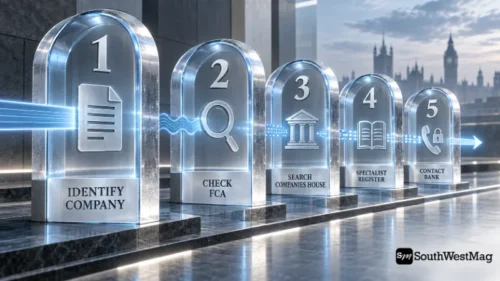
1. Identify the Exact Company Named
Look for the organisation’s full legal or trading name rather than relying solely on a logo.
For example, a letter may display a familiar banking brand while the legal entity appears in smaller regulatory wording.
2. Check the FCA Firm Checker
Where the sender provides regulated financial or consumer-credit services, search the FCA Firm Checker.
Search using the company name or Firm Reference Number, then compare the telephone number, website and other details on the FCA record with the organisation you believe contacted you.
The FCA warns specifically about clone firms, which impersonate genuine authorised businesses while substituting their own contact information.
3. Search Companies House
Use the official Companies House company search to verify that the legal entity exists, whether it is active and where its registered office is.
Companies House is useful for establishing corporate identity, but being registered as a company is not the same as being FCA authorised. Companies House also warns that information filed on the register is not necessarily verified for accuracy.
4. Use the Appropriate Specialist Register
The appropriate check depends on who claims to have sent the letter.
For a consumer-credit or financial firm, the FCA register is normally the most important regulatory check. If the sender says it is a solicitor, check the SRA Solicitors Register.
Debt collection businesses may also belong to the Credit Services Association member directory, while enforcement businesses may appear through CIVEA’s membership information.
CSA or CIVEA membership should be treated as an additional check, not as proof by itself that a debt is valid.
5. Contact the Bank Independently
Do not automatically call the telephone number printed on a suspicious letter.
Instead, obtain the number from the bank’s official website, banking app, bank card or a statement you already know is genuine.
At the time this article was checked, published general contact routes included:
| Brand | Independently published number |
| Lloyds Bank | 0345 300 0000 |
| Bank of Scotland | 0345 721 3141 |
| Halifax | 0345 720 3040 |
These numbers can change, so checking the organisation’s official website immediately before calling remains sensible.
Ask the bank whether the reference number, account and correspondence are genuine. The bank can verify this without relying on the contact details contained in the questionable letter.
What Should You Do If the Debt Is Yours?
First establish who owns the debt, how much is owed and whether the balance is correct.
Do not let an unfamiliar PO Box pressure you into making an immediate payment before those facts are clear.
If the debt is genuine but unaffordable, obtain free debt advice before entering a repayment arrangement that could leave insufficient money for priority expenses such as housing, council tax, energy or food.
If the debt is old, also check whether limitation or prescription rules could apply before making a payment or written acknowledgement.
What If You Do Not Recognise the Debt?
An unexpected letter does not mean the recipient must immediately prove that they do not owe money.
Ask the sender to identify:
- the original creditor;
- the relevant account or agreement;
- when the account was opened;
- how the balance was calculated;
- when the alleged debt arose;
- whether ownership of the debt has been assigned; and
- why the sender believes the recipient is liable.
For regulated consumer-credit agreements, sections 77 to 79 of the Consumer Credit Act 1974 may give the debtor a separate right to request a copy of the relevant agreement and information about the account.
National Debtline explains that the statutory request carries a £1 fee and, where applicable, the creditor normally has 12 working days to comply. Failure to comply does not automatically wipe out the debt, but it can affect enforceability while the failure continues.
Is an Old Debt From PO Box 140 Statute-Barred?
Possibly, but the age of the letter alone is not enough to determine this.
For many ordinary unsecured debts in England and Wales, the usual limitation period is six years.
Broadly, relevant factors include when the creditor’s cause of action arose, whether a payment has been made, whether the debtor acknowledged liability in writing and whether court action was started within the applicable period.
This is why simply counting six years from the date of the last letter can produce the wrong answer.
The position is also different once a court judgment already exists, and some types of debt have different limitation rules.
We has more detail on how long creditors can legally chase a debt in the UK.
What about Scotland?
Scotland operates under different prescription rules.
Many qualifying debts can be extinguished after a five-year prescriptive period if the legal requirements are satisfied. The consequences are different from England and Wales, where a statute-barred debt may continue to exist even though court enforcement is restricted.
FCA debt-collection rules themselves recognise the general six-year limitation period in England, Wales and Northern Ireland and the five-year prescription period in Scotland.
Anyone relying on limitation or prescription should obtain advice about their particular debt before making a payment or written acknowledgement.
What If a PO Box 140 Letter Escalates to a Court Claim?
A debt letter is not a County Court Judgment.
Before many consumer debts reach court, a creditor may issue formal pre-action correspondence, including a Letter of Claim.
Under the debt pre-action process, a debtor is generally given time to respond and request information before proceedings begin. Citizens Advice notes that a Letter of Claim normally gives 30 days to reply.
If actual court proceedings are started, the recipient should receive official claim documentation containing court details and a claim number.
For an ordinary County Court claim, the defendant generally has 14 days after service of the particulars of claim to file a defence.
Filing an Acknowledgment of Service within the relevant period can normally extend the defence deadline to 28 days after service of the particulars.
Ignoring a genuine claim can result in judgment being entered by default. GOV.UK therefore advises recipients to respond by the stated deadline.
If judgment is entered, its effect on a person’s credit record can continue for years. We explains how long a CCJ stays on a UK credit file.
If a court document appears suspicious, verify it using official HM Courts & Tribunals Service contact information, not a telephone number supplied separately by an unknown caller.
What If the Letter Is for Someone Who Does Not Live at Your Address?
A current occupier does not become responsible for another person’s debt simply because correspondence arrives at their property.
Do not provide unnecessary personal financial information to prove that another person has moved away.
For unopened mail, a practical approach is to mark the envelope “Not known at this address – return to sender” and put it back into the postal system.
If repeated letters continue, contact the organisation through independently verified details and tell it that the named person does not live at the address.
If enforcement agents eventually contact the address, it can be useful to have normal evidence showing who actually lives there, but residents should not pay somebody else’s debt simply to stop correspondence.
What If the Letter Could Be Identity Fraud?
If the letter contains an account, loan or other financial product that was never opened by the recipient, treat that differently from an ordinary disputed debt.
Contact the genuine lender immediately using independently obtained details and explain that the account is not recognised.
Check credit information held by Experian, Equifax and TransUnion for unfamiliar applications, accounts, searches or addresses.
If identity information may have been compromised, Cifas Protective Registration can add an extra warning to the person’s identity data so participating organisations conduct additional checks when applications are made.
Cifas currently states that Protective Registration costs £30 for two years and does not itself affect a credit score, although additional identity checks can make applications take longer.
Action Fraud has changed
Older articles may tell readers to report suspected fraud through Action Fraud.
That advice needs updating.
The UK Government’s 2026 Fraud Strategy confirms that the former Action Fraud reporting service has been replaced by Report Fraud.
People in England, Wales and Northern Ireland can now use the Report Fraud service. In Scotland, suspected fraud should generally be reported to Police Scotland on 101.
Keep any crime or report reference number together with copies of letters, envelopes, bank correspondence and credit-file entries.
Copy-and-Paste Letter Templates
These templates are starting points rather than personalised legal advice. Do not include more personal information than is necessary.
Template 1: I Do Not Recognise This Debt
Re: [reference number]
Dear Sir/Madam,
I am writing regarding your correspondence dated [date].
I do not recognise the debt described in your letter and do not currently acknowledge liability for the amount claimed.
Please provide sufficient information for me to identify and verify the account, including:
- the name of the original creditor;
- the original account or agreement reference;
- the date the account was opened;
- a breakdown of the balance claimed;
- details of any assignment or transfer of the debt; and
- the basis on which you believe I am liable.
Until I have been able to verify this information, please communicate with me in writing.
Yours faithfully,
[Name]
National Debtline also provides guidance for people who believe they do not owe a debt.
Template 2: Potentially Statute-Barred Debt — England and Wales
Re: [reference number]
Dear Sir/Madam,
I am writing regarding your correspondence about the above account.
I do not admit liability for the debt.
Based on the information currently available to me, I believe the applicable limitation period may have expired.
Please provide the information on which you rely if you believe the debt remains legally enforceable, including the relevant dates of any payment, written acknowledgement or court proceedings.
Until that information is supplied, please ensure that any further correspondence accurately reflects the legal status of the account.
Yours faithfully,
[Name]
Do not use a statute-barred template merely because a debt appears old. Check the dates and obtain independent advice first. National Debtline has dedicated guidance and sample correspondence for limitation issues.
Template 3: Previous Occupier
Re: [reference number, if visible without opening another person’s mail]
Dear Sir/Madam,
The person named in your correspondence does not live at this address.
Please update your records and stop sending correspondence for that individual to this property.
I am not providing a forwarding address and cannot confirm the person’s present whereabouts.
Yours faithfully,
[Current occupier]
For unopened letters, simply writing “Not known at this address – return to sender” on the envelope may be sufficient as a first step.
Frequently Asked Questions
Is PO Box 140 Normanton WF6 1YA a scam?
The address itself does not appear to be a fake address. Current public postcode data associates PO Box 140, WF6 1YA with HBOS plc. However, scammers can copy genuine addresses, so an unexpected letter should still be independently verified.
Is PO Box 140 Normanton Lloyds Bank?
The strongest evidence identifies HBOS plc rather than Lloyds Bank as the addressee associated with the postcode. HBOS plc is, however, a wholly owned subsidiary of Lloyds Bank plc, making the Lloyds connection genuine.
Is PO Box 140 Normanton Halifax?
Halifax has a historic corporate relationship with HBOS and Lloyds Banking Group, but this research found insufficient direct evidence to state that all or specifically Halifax correspondence is issued from PO Box 140. Verify a Halifax letter independently.
Is PO Box 140 Normanton Bank of Scotland?
There is historical recipient evidence of Bank of Scotland correspondence using the address, including a reported 2019 tax-residency letter. That is useful evidence of historical use but should not be treated as proof of the sender of every current letter.
Is PO Box 140 Normanton a debt collector?
There is not enough reliable evidence to identify the PO Box itself as belonging to a specific debt collection agency. The strongest current address evidence points to HBOS plc.
If a debt collector’s name appears inside the letter, verify that company separately through the FCA and other relevant registers.
Why have I received a letter from PO Box 140?
Possible reasons depend entirely on the sender and can include banking administration, account correspondence, lending, historic financial products, complaints, verification or debt-related matters. The PO Box itself does not reveal the purpose.
Should I call the telephone number printed on the letter?
For an unexpected or suspicious letter, use the bank or company’s number obtained independently from its official website, app, bank card or FCA record instead.
Can a company using PO Box 140 take me to court?
Potentially, if it is the creditor or legally entitled owner of an enforceable debt and follows the relevant procedure. The PO Box address itself neither creates nor removes the right to bring a claim.
Is a letter from PO Box 140 already a CCJ?
No. An ordinary bank or debt letter is not a CCJ. A County Court Judgment arises only after court proceedings reach the judgment stage.
What happens if I ignore a genuine County Court claim?
Ignoring a genuine claim can allow the claimant to seek judgment by default. Respond by the deadline shown on authenticated court documents.
Can an old debt still be collected after six years?
It depends on the debt, relevant dates, acknowledgements, payments and whether proceedings have already been started.
Many ordinary unsecured debts in England and Wales are subject to a six-year limitation period, while Scotland has separate five-year prescription rules for many obligations.
What should I do if the letter belongs to a previous resident?
Return unopened mail marked “Not known at this address – return to sender”. If correspondence continues, contact the genuine organisation independently and ask it to correct its records.
What should I do if an account in the letter was opened in my name without permission?
Contact the genuine financial institution immediately, inspect your credit reports and report suspected fraud through the appropriate national service.
Since 2026, England, Wales and Northern Ireland use Report Fraud, while Scotland generally directs fraud reports to Police Scotland.