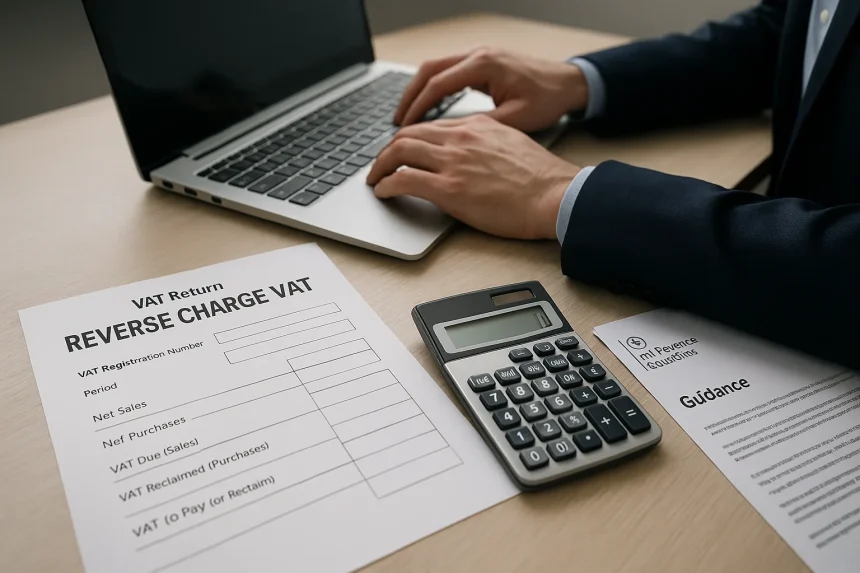
If you run a VAT-registered business in the UK, you’ve likely heard of the reverse charge VAT mechanism—but do you know when and how it applies? Designed to prevent VAT fraud, particularly in high-risk sectors like construction and electronics, reverse charge VAT shifts the responsibility for reporting and paying VAT from the supplier to the customer.
This change in accounting affects both domestic and cross-border transactions, and it’s vital for businesses to understand their obligations. Without proper knowledge, mistakes can lead to compliance issues, cash flow problems, or unexpected liabilities.
Whether you’re a contractor, importer, or service provider, grasping how this rule operates is essential for accurate VAT returns and business efficiency.
In this article, you’ll get a clear, practical understanding of reverse charge VAT in the UK and how it may affect your business, helping you stay compliant and confident in your financial reporting.
What Is Reverse Charge VAT and Why Does It Exist?
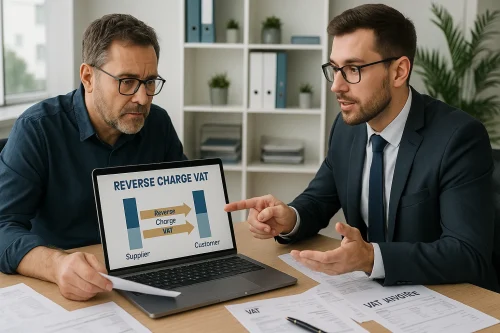
Reverse charge VAT is a tax accounting method where the responsibility for reporting VAT shifts from the supplier to the customer. Unlike the standard VAT system where the seller adds VAT to the invoice and pays it to HMRC, the reverse charge requires the buyer to account for both output and input VAT on their VAT return.
This mechanism was introduced by HMRC as part of its anti-fraud strategy, especially for sectors vulnerable to tax evasion. It ensures that VAT is accounted for by the person receiving the goods or services, which significantly reduces the risk of the supplier collecting VAT and disappearing without remitting it to the tax authority.
It’s particularly relevant to sectors with a history of carousel fraud, such as mobile phones and computer chips, and also widely used in the construction industry.
Reverse charge VAT is now a critical part of the UK’s tax compliance framework, and it’s important for businesses to know when it applies to ensure proper VAT reporting and avoid penalties.
How Does the Reverse Charge Mechanism Actually Work in the UK?
In a standard VAT transaction, the seller adds VAT to their invoice, collects the money from the buyer, and pays it to HMRC. Under the reverse charge system, the seller does not charge VAT, and the buyer becomes responsible for accounting for it.
This means:
- The invoice must state that reverse charge VAT applies and specify the amount or rate.
- The supplier records only the net sale value in box 6 of their VAT return.
- The buyer declares the VAT on both the output (box 1) and input (box 4) sides of their return.
- The buyer also reports the net purchase value in box 7.
The practical effect is usually VAT neutral if the buyer can reclaim full input tax. However, it’s still essential that the accounting is correctly handled. One missed entry can result in inaccurate VAT filings, which could trigger audits or penalties.
For consistency, the date used for VAT purposes is the invoice date, not when payment is made, even under the cash accounting scheme.
When Does Reverse Charge VAT Apply in the UK?
Reverse charge VAT applies in two main situations: cross-border services and certain domestic supplies.
In the UK, it’s commonly used for:
- Services received from suppliers based outside the UK
- Domestic B2B transactions in high-risk sectors like construction, mobile phones, telecommunications, and wholesale energy
Understanding when to use reverse charge VAT depends on the nature of the goods or services and the status of both parties.
Below is a simplified overview:
| Scenario | Does Reverse Charge Apply? |
| Buying services from overseas (non-UK supplier) | Yes |
| UK construction services under CIS | Yes |
| Buying mobile phones over £5,000 | Yes |
| Supplies to private individuals | No |
| End users in construction projects | No (if notified) |
| Imports under postponed VAT accounting | Yes |
In each applicable scenario, the customer must be VAT-registered and report the VAT accordingly. Failing to apply the reverse charge correctly can lead to incorrect VAT returns or unclaimed input tax.
Which Construction Services Are Affected by Reverse Charge VAT?
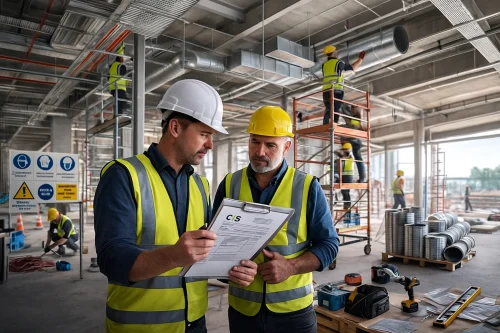
The construction industry is one of the most impacted by reverse charge VAT rules. Since 1 March 2021, most supplies of construction services between VAT-registered businesses under the Construction Industry Scheme (CIS) fall under this mechanism. The charge applies to both labour and materials supplied as part of a job.
The following services fall within the reverse charge VAT scope:
- Construction, alteration, repair, extension, or demolition of buildings and structures
- Installation of systems for heating, power, drainage, or ventilation
- Internal cleaning related to construction work
- Painting and decorating (interior and exterior)
- Site preparation services such as earth-moving and scaffolding
However, there are exceptions where reverse charge does not apply, including:
- Professional services from architects or surveyors
- Installation of security systems or signage
- Repairs of seating or blinds
- Work for end users, such as property owners not intending to sell on the service
To apply the reverse charge correctly, both the buyer and supplier must be VAT and CIS registered, and the buyer must not be an end user.
How Does Reverse Charge VAT Affect Cross-Border Services and Imports?
When UK businesses purchase services from suppliers based outside the UK, reverse charge VAT generally applies. This is because overseas suppliers are usually not registered for UK VAT and thus do not charge VAT on their invoices. However, the place of supply is still considered the UK, making the buyer responsible for reporting VAT.
For goods imports, businesses can opt to use Postponed VAT Accounting (PVA). With PVA, you do not pay VAT at the border. Instead, you account for it on your next VAT return by entering the amount as both output and input tax, improving cash flow. To use PVA, your business must be VAT registered and have an EORI number.
Failure to account for reverse charge VAT correctly on imports or services can lead to unexpected VAT liabilities or missed reclaim opportunities. Cross-border transactions must be monitored carefully in VAT returns, especially for businesses using overseas suppliers or digital services.
What Should You Include on a Reverse Charge VAT Invoice?
When issuing an invoice under the reverse charge, the supplier must not charge VAT but is required to include specific wording and details to indicate that the customer is responsible for VAT accounting. This helps both parties fulfil their reporting obligations accurately.
Key elements that must be included on the invoice are:
- A clear statement like “Reverse charge Customer to pay the VAT to HMRC”
- The VAT rate that would have applied (typically 5% or 20%)
- The customer’s VAT registration number
- The supplier’s VAT number
- A breakdown of the net amount
- No VAT charged on the total
- The total payable excluding VAT
Invoices missing this information can create confusion or cause errors in reporting. Suppliers must also retain proof that the buyer is VAT registered and, where applicable, is not classed as an “end user” for construction services.
What Are the Common Mistakes UK Businesses Make with Reverse Charge VAT?
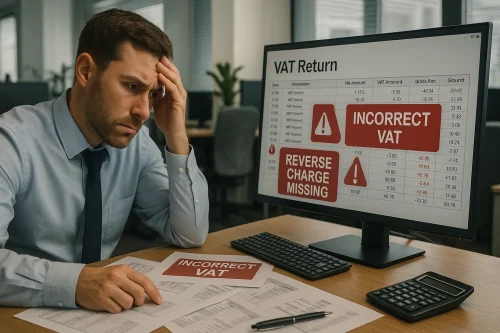
Reverse charge VAT can be complex, and many businesses unknowingly make mistakes that affect their VAT returns or lead to penalties. Misunderstandings often stem from eligibility, documentation, or incorrect treatment in accounting software.
Common mistakes include:
- Charging VAT when reverse charge should apply
- Omitting the reverse charge statement on invoices
- Failing to include the correct entries in VAT boxes 1, 4, 6, or 7
- Misclassifying a customer as an end user or vice versa
- Not updating accounting software to handle reverse charge entries
- Forgetting that services bought from abroad count toward VAT registration thresholds
Understanding the full implications of each transaction and double-checking the parties’ VAT and CIS status helps reduce the risk of error. Always refer to HMRC guidance or seek professional advice if uncertain.
What Should You Do to Stay Compliant with Reverse Charge VAT Rules?
To ensure compliance, businesses should first determine whether they are in a reverse charge supply chain. Check both your suppliers’ and your own VAT and CIS registration status, and confirm if the customer is an “end user.”
Once verified, businesses must:
- Update accounting systems to handle reverse charge correctly
- Train staff responsible for VAT reporting
- Ensure invoices reflect reverse charge requirements
- Use the invoice date for reporting, not payment date
- Monitor transactions that affect your VAT registration threshold
Staying compliant isn’t just about avoiding penalties. It also ensures accurate VAT returns, supports HMRC inspections, and improves cash flow when used correctly.
How Can Reverse Charge VAT Impact Cash Flow and VAT Returns?
Reverse charge VAT can significantly affect how and when VAT is reported, impacting cash flow and administrative planning. Since VAT is not physically paid between supplier and customer, there are implications for how money moves through your business.
Some key impacts include:
- No VAT payment upfront, improving liquidity for the customer
- Faster input tax recovery, especially when using Postponed VAT Accounting
- Reduced risk of VAT fraud, supporting financial integrity
- Less cash flow strain for frequent importers or construction firms
- Accurate reporting obligations, with focus on invoice dates and box entries
By understanding these changes, businesses can optimise their cash flow while staying aligned with HMRC rules. Accurate and timely VAT returns are essential to ensure these benefits are realised.
Who Is Exempt or Not Affected by the Reverse Charge VAT Rules?
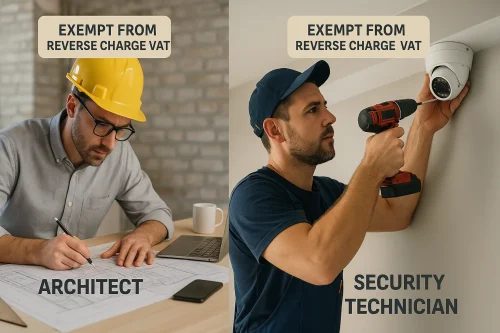
Not every transaction qualifies for reverse charge VAT, and there are clear exemptions set by HMRC. Knowing these can help avoid misapplying the rule, which could lead to compliance issues or incorrect VAT claims.
Reverse charge VAT does not apply to:
- End users in construction projects who use the service themselves
- Consumers and non-VAT-registered individuals
- Professional services such as architects and surveyors
- Artistic work installations including murals and sculptures
- Signage, blinds, and seating installations
- Security systems like CCTV or alarms
- Deliveries of materials or prefabricated systems without installation
Additionally, where services are supplied on their own and not part of a CIS project, normal VAT rules continue to apply. Always assess the full scope of the transaction and consult guidance when needed.
Conclusion
Reverse charge VAT is a powerful mechanism introduced to tackle fraud and strengthen compliance in the UK tax system. It places the responsibility for VAT reporting on the buyer, shifting away from the traditional model and altering how invoices, returns, and cash flows are managed.
Whether you’re a contractor, service importer, or wholesale trader, understanding your role in this process is essential. By identifying when the reverse charge applies, updating your systems, and ensuring correct invoice language and VAT return entries, you can protect your business from errors and penalties.
For those working in construction or importing services, staying ahead of these rules ensures smooth, compliant operations. Ultimately, knowing how reverse charge VAT works is not just about ticking a box—it’s about building confidence in your financial systems and helping your business thrive under UK VAT regulations.
FAQs
What does reverse charge mean on a VAT invoice?
It means the customer, not the supplier, is responsible for reporting and paying VAT to HMRC. The invoice should state this clearly.
Does reverse charge VAT apply to all construction work in the UK?
No, it only applies to construction services under CIS between VAT-registered businesses. End users and exempt services are excluded.
How do I know if I’m classed as an end user under CIS?
An end user is a business or individual who does not make onward supplies of the construction service. They must inform the supplier in writing.
Can I use reverse charge VAT if I’m not VAT-registered?
No, reverse charge VAT only applies to VAT-registered businesses. If you’re not registered, standard VAT rules apply.
How do I report reverse charge VAT on my VAT return?
Include the VAT amount as both output tax in box 1 and input tax in box 4. Also report the net amounts in boxes 6 and 7.
Is reverse charge VAT the same for imports and services?
The principle is similar, but imports use postponed VAT accounting, while services require self-accounting on domestic returns.
What happens if I apply reverse charge incorrectly?
Incorrect application can lead to misfiled VAT returns, potential fines, and audits from HMRC. Always check if the rule applies.