Stockport is in Greater Manchester, in North West England. More precisely, it is the main town of the Metropolitan Borough of Stockport and has been part of the metropolitan county of Greater Manchester since the major local government changes of 1974.
However, Stockport has a more complicated historic county identity. Most of the town lies within the historic county of Cheshire, while areas north of the River Mersey historically belonged to Lancashire.
That explains why Stockport can still be strongly associated with Cheshire even though its modern county is Greater Manchester.
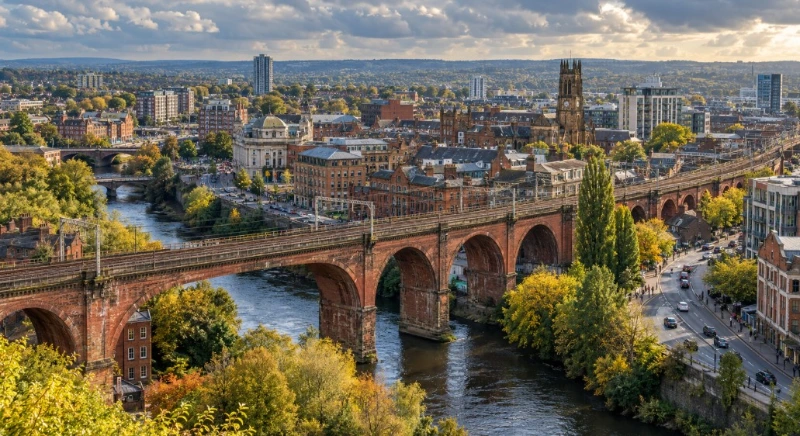
Stockport lies around 6 miles south-east of Manchester city centre, close to communities including Cheadle, Bramhall, Hazel Grove, Marple and Denton. The rivers Goyt and Tame meet in the town to form the River Mersey, while the famous Stockport Viaduct remains one of its most recognisable landmarks.
Where Exactly Is Stockport Located in the UK?
The town sits close to the southern edge of Greater Manchester and near the modern boundary with Cheshire. Manchester city centre is approximately 6 miles north-west, while Macclesfield lies around 12 miles to the south.
Stockport occupies an important geographical position because it links the heavily urbanised Greater Manchester area with communities further south in Cheshire and towards the Peak District.
Its landscape is also distinctive.
The rivers Goyt and Tame meet in Stockport to form the River Mersey, creating one of the town’s defining geographical features. Much of the town centre developed on elevated sandstone ground overlooking these river valleys.
For anyone locating Stockport within the wider UK, the hierarchy is straightforward:
- Town: Stockport
- Metropolitan Borough: Stockport
- Metropolitan County: Greater Manchester
- Region: North West England
- Country: England
- Sovereign State: United Kingdom
What County Is Stockport In and Why Is It Significant?
Stockport is in the metropolitan county of Greater Manchester.
Greater Manchester was created in 1974 and includes Stockport alongside Manchester, Salford, Bolton, Bury, Oldham, Rochdale, Tameside, Trafford and Wigan.
Understanding Manchester’s county status helps explain the wider structure because Manchester itself is also part of Greater Manchester rather than forming a separate traditional county.
Stockport’s inclusion in Greater Manchester reflects its economic, transport and urban connections with the wider Manchester area.
However, Greater Manchester is only part of the story.
Historically, most of Stockport belonged to Cheshire. The area north of the River Mersey was historically associated with Lancashire, meaning the modern town developed across an old county boundary.
Why Stockport’s County Matters
Knowing Stockport’s county is useful for far more than simply identifying it on a map.
County and administrative boundaries can affect how people understand:
- Local government
- Historic records
- Property locations
- Regional transport
- Ceremonial geography
- Genealogy
- Local identity
- Emergency services
- Regional statistics
Someone researching a Stockport ancestor from the nineteenth century, for example, may encounter Cheshire or Lancashire records rather than Greater Manchester.
Someone dealing with modern local services will instead use Stockport Council and organisations operating across Greater Manchester.
Both descriptions can therefore make sense depending on the period being discussed.
Is Stockport in Cheshire or Greater Manchester?
Stockport is in Greater Manchester today, while most of the town is historically part of Cheshire.
This is the most important distinction when answering what county is Stockport in.
Before 1974, Stockport had much stronger formal administrative connections with Cheshire. However, the town itself had developed across the historic Cheshire-Lancashire boundary because the River Mersey traditionally separated parts of the two counties.
Most of central Stockport and the land south of the Mersey belonged historically to Cheshire.
Heaton Norris and other areas north of the river had historic Lancashire connections.
Local government was reorganised on 1 April 1974, when the modern Metropolitan Borough of Stockport became part of the newly created metropolitan county of Greater Manchester.
Stockport did not physically move. The administrative boundaries around it changed.
Therefore:
| County Description | Stockport’s Position |
| Modern Metropolitan County | Greater Manchester |
| Historic County | Mainly Cheshire |
| Historic Area North of the Mersey | Lancashire |
| English Region | North West England |
| Current Local Authority | Stockport Metropolitan Borough Council |
For a modern address, official regional description or local government context, Greater Manchester is the appropriate county.
For genealogy, historic geography or older cultural identity, Cheshire may be equally important.
What Type of County Is Greater Manchester for Stockport?
Greater Manchester is a metropolitan county created during the local government reorganisation of 1974. It brought together major urban areas surrounding Manchester that had previously been divided among historic counties, particularly Lancashire and Cheshire.
The original Greater Manchester County Council was abolished in 1986. That did not mean Greater Manchester stopped existing as a geographical or ceremonial area.
Stockport Metropolitan Borough Council subsequently assumed additional responsibilities, while many strategic functions are now coordinated across Greater Manchester.
That is why Greater Manchester remains the clearest answer when someone asks what county Stockport is in today.
Are There Other Places Called Stockport?
Stockport in Greater Manchester is by far the best-known place with the name in the UK.
The name can occasionally appear elsewhere internationally or in business and family names, but a UK reference to Stockport almost always means the town south-east of Manchester.
People from Stockport are traditionally called Stopfordians. The term comes from historic variations of the town’s name, including Stopford, rather than from its modern spelling.
Is Stockport a Town, a County, or Both?
Stockport is a town, not a county and not a city. It is also the principal settlement within the wider Metropolitan Borough of Stockport.
The distinction matters because the word Stockport can describe slightly different geographical areas.
When someone says Stockport, they may mean the central town and its continuous built-up area. In local government statistics, however, Stockport can mean the entire metropolitan borough, which includes many separate communities.
The wider borough contains places such as:
- Bramhall
- Bredbury
- Brinnington
- Cheadle
- Cheadle Hulme
- Gatley
- Hazel Grove
- Heald Green
- Marple
- Reddish
- Romiley
- Woodley
These communities form part of the Metropolitan Borough of Stockport but are not simply neighbourhoods of Stockport town centre.
Stockport has also never been made a city.
Its substantial population, economy and transport connections do not automatically give it city status.
Stockport’s Geographical and Administrative Identity
Stockport combines several different geographical identities.
It is simultaneously a historic Cheshire town, part of modern Greater Manchester, a major settlement in North West England and the administrative centre of a metropolitan borough.
Understanding those layers prevents much of the confusion surrounding its county.
Stockport: Geographical and Administrative Profile (2026)
| Category | Stockport |
| Settlement Type | Town |
| Metropolitan Borough | Stockport |
| Modern County | Greater Manchester |
| Historic County | Mainly Cheshire |
| Historic County North of Mersey | Lancashire |
| Region | North West England |
| Country | England |
| Main Rivers | Goyt, Tame and Mersey |
| Main Post Town | STOCKPORT |
| Main Postcode Districts | SK1 to SK7 |
| Telephone Code | 0161 |
| Nearby Major City | Manchester |
| Local Authority | Stockport Metropolitan Borough Council |
| Parliamentary Representation | Stockport, Cheadle and Hazel Grove constituencies |
The combination of Greater Manchester administration and Cheshire heritage gives Stockport a distinctive identity compared with many English towns.
A Brief History of Stockport’s County and Governance
Stockport’s administrative history stretches back centuries. The town developed close to an important crossing of the River Mersey and was recorded as Stokeport in the twelfth century.
A borough charter was granted around 1220, providing the foundations for local government for hundreds of years. Stockport later became a municipal borough in 1836.
Its boundaries had expanded beyond the historic Cheshire side of the Mersey, meaning the borough eventually included territory that had traditionally been part of Lancashire.
When elected county councils were established in 1889, Stockport became a county borough.
That status allowed the borough to provide county-level services independently rather than being directly administered by Cheshire County Council or Lancashire County Council.
The most significant modern change came in 1974. The old County Borough of Stockport was combined with neighbouring areas to create the modern Metropolitan Borough of Stockport.
At the same time, the new borough became part of the newly created metropolitan county of Greater Manchester.
The Greater Manchester County Council was later abolished in 1986, but Stockport remained part of Greater Manchester.
Its history therefore follows a clear progression:
- Historic period: Mainly within Cheshire, with northern areas linked to Lancashire
- 1836: Municipal borough established under reformed local government
- 1889: Stockport became a county borough
- 1974: Metropolitan Borough of Stockport created within Greater Manchester
- 1986: Greater Manchester County Council abolished
- Today: Stockport Council provides borough-level services while wider Greater Manchester bodies coordinate strategic functions
What Makes Stockport Important Within Greater Manchester?
Stockport occupies an important position on the southern side of Greater Manchester.
It acts as a connection between Manchester and communities across Cheshire, while major road and rail routes pass directly through the town.
Stockport railway station is particularly important because it sits on routes between Manchester and destinations further south.
The town is also a significant residential and employment centre in its own right rather than simply functioning as a commuter settlement.
Its industrial heritage contributed heavily to its development.
Stockport became particularly associated with textiles, engineering and hat manufacturing during the Industrial Revolution. At its peak, the local hatting industry produced goods for markets across Britain and overseas.
Modern Stockport has a much more diverse economy, while regeneration has brought new housing, leisure facilities and commercial development into the centre.
How Is Stockport Governed Today?
Stockport is governed locally by Stockport Metropolitan Borough Council. The council operates at metropolitan borough level and is responsible for major local services across the borough.
These include areas such as:
- Adult social care
- Children’s services
- Council Tax
- Housing functions
- Planning
- Waste collection
- Roads
- Libraries
- Parks and public spaces
- Local regeneration
Stockport is also one of the ten metropolitan boroughs that make up Greater Manchester.
Some issues extending beyond one borough, particularly strategic transport, economic development and wider regional planning, involve organisations working across Greater Manchester.
This does not mean Manchester City Council controls Stockport. Stockport Council and Manchester City Council are separate local authorities.
Similarly, Stockport is not administered by Cheshire East Council or Cheshire West and Chester Council despite its historic association with Cheshire.
Will Stockport’s Local Government Structure Change?
English local government has changed repeatedly over time, so administrative arrangements can evolve.
However, any future reform should be separated from Stockport’s existing county identity.
Stockport currently remains a metropolitan borough within Greater Manchester.
Changes to regional powers, transport responsibilities, planning arrangements or devolution would not automatically mean that Stockport had returned to Cheshire or become a county of its own.
This distinction is important whenever proposed local government reforms are discussed.
A council structure can change while the broader ceremonial or geographical identity remains unchanged.
Stockport’s Wider Civic and Heritage Role
Stockport has maintained a strong independent civic identity despite its close relationship with Manchester.
Its historic Market Place, Town Hall, industrial buildings and cultural venues reflect a town that developed its own institutions long before Greater Manchester existed.
The term Stopfordian continues to reinforce that independent identity. For many residents, describing Stockport solely as part of Manchester would therefore overlook centuries of separate local development.
Top Things Stockport Is Known For
Stockport has several landmarks, industries and cultural institutions that distinguish it from neighbouring towns.
1. Stockport Viaduct
Stockport Viaduct is one of the town’s most recognisable structures.
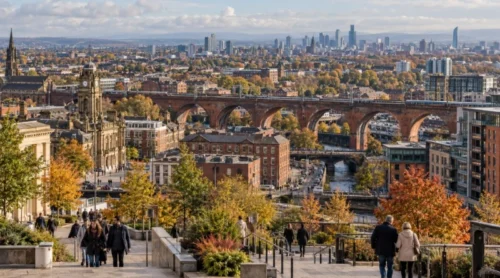
Completed in 1840, the enormous brick railway viaduct crosses the River Mersey valley and carries the main railway through the town.
Its 27 arches dominate views across central Stockport.
The viaduct remains an important piece of Victorian engineering as well as a working part of the modern railway network.
2. Hat Works and Stockport’s Hatting Heritage
Stockport was once one of Britain’s leading centres for hat manufacturing.
By the late nineteenth century, millions of hats were being exported annually from the area.
The industry declined during the twentieth century, and the last hat factory in Stockport closed in 1997.
That heritage survives through Hat Works, a museum dedicated to the history of hatting and headwear.
The connection is also reflected in the nickname of Stockport County Football Club, The Hatters.
3. Stockport Air Raid Shelters
Stockport’s sandstone geology allowed an extensive system of underground air raid shelters to be created during the Second World War.
The tunnels provided protection for thousands of local residents during air raids.
Today, the surviving shelters provide an unusual insight into civilian life during wartime Britain and remain one of the town’s most distinctive heritage attractions.
4. Market Place and the Underbanks
Stockport’s historic centre developed around its Market Place and nearby streets. The area contains some of the town’s oldest surviving buildings, including Staircase House and Underbank Hall.
Narrow streets, historic shopfronts and buildings from different periods create a very different atmosphere from the larger modern shopping areas nearby.
The district also illustrates how Stockport grew around its medieval commercial centre long before its later industrial expansion.
5. Stockport County Football Club
Stockport County is one of the town’s best-known sporting institutions. The club plays at Edgeley Park and is traditionally nicknamed The Hatters in recognition of Stockport’s historic hat-making industry.
Football plays an important part in modern local identity and provides another example of Stockport maintaining a distinct civic identity within Greater Manchester.
6. The Plaza
The Plaza is a historic entertainment venue dating from the early 1930s. Its distinctive architecture and continuing use for performances, cinema and events have made it an important part of Stockport’s cultural landscape.
It represents an era when elaborate cinemas and variety theatres were major centres of entertainment in British towns.
7. The River Mersey
Stockport has an unusual relationship with the River Mersey because the river begins within the town. The rivers Goyt and Tame meet close to the centre of Stockport and combine to form the Mersey.
The river then continues west through Greater Manchester before eventually reaching Liverpool Bay. This gives Stockport an important position in the geography of one of North West England’s best-known river systems.
Stockport Population in 2026: Latest Available Figures
There is no separate 2026 census population figure for Stockport. The latest full UK census was carried out in 2021, so those figures remain the most useful benchmark for comparing the town and the wider borough.
The 2021 Census recorded approximately 294,800 people in the Metropolitan Borough of Stockport.
The Stockport built-up area was considerably smaller, with a population of 117,935.
The difference exists because the metropolitan borough covers a much larger geographical area containing communities such as Bramhall, Cheadle, Hazel Grove, Marple and Reddish.
Stockport Population Insights
| Population Measure | Figure |
| Stockport Built-Up Area, 2021 | 117,935 |
| Metropolitan Borough, 2021 | About 294,800 |
| Metropolitan Borough, 2011 | About 283,300 |
| Borough Growth 2011–2021 | About 4.1% |
Stockport’s borough population increased between the 2011 and 2021 censuses. Population figures should always be read carefully because the number depends on which Stockport boundary is being measured.
A figure for Stockport town alone will therefore be significantly lower than one covering the entire metropolitan borough.
Why Is Stockport Important in Greater Manchester’s Identity?
Stockport contributes to Greater Manchester through its economy, transport connections, industrial heritage, residential communities and distinctive civic identity.
Its location on the southern side of the county also makes it an important connection between Greater Manchester and Cheshire.
1. Economic Strength
Stockport developed as a major industrial town but today supports a much broader economy.
Retail, professional services, manufacturing, technology, healthcare, hospitality and public-sector employment all contribute to the borough.
Its proximity to Manchester and Manchester Airport also makes Stockport attractive to commuters and businesses requiring access to the wider North West.
2. Cultural and Industrial Heritage
Stockport’s identity has been shaped by silk, cotton, engineering and particularly hat manufacturing. Historic factories, warehouses, markets and transport structures remain visible throughout the town.
The Hat Works, Stockport Viaduct, Air Raid Shelters, Staircase House and Market Place help connect modern Stockport with its industrial and civic history.
This heritage gives Stockport a cultural identity that is distinct from neighbouring Manchester and Salford’s place within Greater Manchester.
3. Urban Growth and Development
Stockport has continued to evolve from its industrial past into a mixed residential, business and leisure centre.
Former industrial areas have increasingly been reused for housing and commercial development.
Regeneration around the town centre, transport interchange and historic districts has also strengthened connections between different parts of central Stockport.
The challenge is to accommodate modern development while retaining landmarks and neighbourhoods that give the town its identity.
What Are the Nearest Towns and Communities to Stockport?
Stockport is surrounded by numerous towns and suburban communities across southern Greater Manchester.
Distances below are approximate and measured from central Stockport.
1. Hazel Grove – Around 3 Miles South-East
Hazel Grove lies immediately south-east of Stockport.
It forms part of the Metropolitan Borough of Stockport and developed significantly as residential growth spread along the A6 corridor.
2. Cheadle – Around 3 Miles South-West
Cheadle lies to the south-west of Stockport and is also within the Metropolitan Borough of Stockport.
It retains a distinct centre and local identity despite being part of the wider Greater Manchester urban area.
3. Bramhall – Around 3 Miles South
Bramhall is situated south of Stockport and close to the modern Greater Manchester-Cheshire boundary.
The area is particularly associated with Bramall Hall, a historic timber-framed manor house.
4. Denton – Around 4 Miles North-East
Denton lies north-east of Stockport within the neighbouring Metropolitan Borough of Tameside.
Like Stockport, Denton historically developed an important hat-making industry.
5. Marple – Around 4 Miles East
Marple lies east of Stockport towards the Pennine foothills.
It forms part of the Metropolitan Borough of Stockport but has a more suburban and semi-rural character than the central town.
What Are the Cities That Are Close to Stockport?
Stockport’s location gives residents relatively easy access to several major cities across North West England and the Midlands.
Distances are approximate centre-to-centre measurements and will vary according to the route used.
1. Manchester – Around 6 Miles North-West
Manchester is by far the closest major city to Stockport.
The two are linked by frequent road, rail and bus connections, and much of the intervening area is continuously developed.
Despite this close connection, Stockport is not administratively part of the City of Manchester.
2. Salford – Around 8 Miles North-West
Salford lies immediately west of Manchester and around 8 miles from central Stockport.
Both Stockport and Salford form separate metropolitan boroughs within Greater Manchester.
3. Sheffield – Around 28 Miles East
Sheffield lies east of Stockport across the Pennine landscape.
Road and rail connections link the two areas, although the surrounding hills make the geography very different from routes towards Manchester.
4. Chester – Around 34 Miles South-West
Chester lies south-west of Stockport in Cheshire. The historic association between Stockport and Cheshire helps explain why the two places may appear together in older records despite Stockport now being within Greater Manchester.
5. Liverpool – Around 35 Miles West
Liverpool lies west of Stockport towards the Irish Sea.
The two places are connected through the wider transport network of North West England and also share a geographical connection through the River Mersey system.
How Well Connected Is Stockport?
Stockport is one of the better-connected large towns in North West England.
Its position immediately south of Manchester places it close to major motorways, railway routes and Manchester Airport.
1. Road Network
The M60 motorway passes directly through Stockport and forms part of the orbital motorway around Greater Manchester. The A6 is another important route.
It passes through Stockport and provides connections north towards Manchester and south towards communities including Hazel Grove.
Other local roads connect Stockport with Cheadle, Bramhall, Marple, Denton and communities across southern Greater Manchester.
2. Rail Connections
Stockport railway station is one of the town’s biggest transport advantages. It lies on a major railway corridor immediately south of Manchester and provides connections towards destinations across Britain.
Manchester Piccadilly is only a short rail journey away, while longer-distance routes connect Stockport with cities and towns further south, east and west.
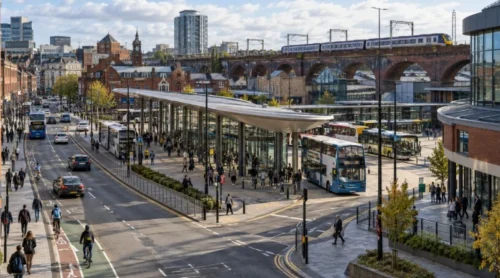
The railway also crosses one of the town’s defining landmarks, Stockport Viaduct.
Stockport does not currently have a Metrolink tram service, although improved rapid-transit connections with the wider Greater Manchester network have been discussed for many years.
3. Public Transport
Bus services connect central Stockport with communities across the borough as well as neighbouring parts of Greater Manchester.
Stockport Interchange replaced the former central bus station and has strengthened connections between bus services, the town centre and railway station.
The town’s close relationship with Manchester means public transport plays an important role for commuting, shopping, education and leisure journeys.
4. Cycling and Walking Infrastructure
Walking and cycling routes are becoming increasingly important as former industrial areas and town-centre sites are redeveloped.
The compact nature of central Stockport means many major destinations are within relatively short walking distances of the railway station and transport interchange.
Routes following rivers, parks and residential neighbourhoods also provide connections beyond the immediate centre.
5. Manchester Airport
Manchester Airport lies only around 5 miles south-west of Stockport. This gives the town convenient access to one of the UK’s largest international airports.
The proximity of the airport is particularly important for residents, businesses and employers across southern Greater Manchester.
Conclusion
So, what county is Stockport in? Stockport is in Greater Manchester, within North West England.
The modern answer is straightforward, but Stockport’s history explains why Cheshire is still frequently associated with the town.
Most of Stockport historically belonged to Cheshire, while parts north of the River Mersey were historically in Lancashire. The situation changed in 1974 when the Metropolitan Borough of Stockport became part of the newly created Greater Manchester metropolitan county.
Stockport is therefore a town in Greater Manchester with a strong historic Cheshire identity.
It is not a separate county, it is not part of the City of Manchester and it does not currently belong to administrative Cheshire.
Its position between Manchester and Cheshire, combined with its industrial heritage, major railway connections, famous viaduct, hat-making history and distinctive town centre, has given Stockport an identity of its own within Greater Manchester.
Frequently Asked Questions
What County Is Stockport In?
Stockport is in Greater Manchester, in North West England. It has been part of Greater Manchester since the local government reorganisation of 1974.
Is Stockport in Cheshire or Greater Manchester?
Stockport is officially in Greater Manchester today, although most of the town historically belonged to Cheshire. This historic connection is why Stockport is still often associated with Cheshire.
Was Stockport Ever Part of Lancashire?
Parts of Stockport north of the River Mersey were historically within Lancashire. Most areas south of the river were traditionally part of Cheshire.
Is Stockport Part of Manchester?
Stockport is part of Greater Manchester, but it is not part of the City of Manchester. It has its own local authority called Stockport Metropolitan Borough Council.
Is Stockport a Town or a City?
Stockport is officially a town, not a city. It is also the main settlement within the wider Metropolitan Borough of Stockport.
When Did Stockport Become Part of Greater Manchester?
Stockport became part of Greater Manchester on 1 April 1974. The change happened under the Local Government Act 1972 when metropolitan counties and new borough boundaries were introduced.
What Region Is Stockport In?
Stockport is in the North West England region. It lies around 6 miles south-east of Manchester city centre.
What Is Stockport Famous For?
Stockport is well known for Stockport Viaduct, its historic hat-making industry, Stockport County FC and the Air Raid Shelters. It is also where the rivers Goyt and Tame meet to form the River Mersey.
What Is the Historic County of Stockport?
The historic county associated with most of Stockport is Cheshire. Some northern parts of the modern town and borough have historic links with Lancashire.
What Is the Population of Stockport?
The 2021 Census recorded about 294,800 people in the Metropolitan Borough of Stockport. The smaller Stockport built-up area had a population of 117,935.
What Council Area Is Stockport In?
Stockport is governed by Stockport Metropolitan Borough Council. The council covers Stockport and surrounding communities including Bramhall, Cheadle, Hazel Grove, Marple and Reddish.
Is Stockport Close to Manchester?
Yes, Stockport is approximately 6 miles south-east of Manchester city centre. Frequent rail, road and bus connections make travel between the two areas relatively easy.