
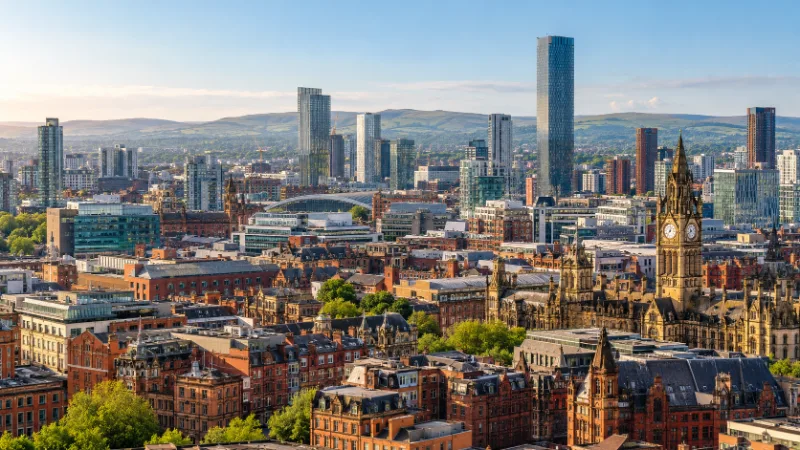
Manchester is in Greater Manchester, a metropolitan and ceremonial county in North West England. However, the city was historically associated with Lancashire before local government boundaries changed on 1 April 1974.
This distinction explains why Manchester is sometimes described as being in Lancashire, while modern maps and administrative records place it within Greater Manchester.
The city itself is only one part of the wider county, which includes ten metropolitan boroughs, such as Salford, Bolton, Stockport, Trafford and Wigan.
Understanding Manchester’s location requires looking at its historic county, modern boundaries, local government and relationship with the surrounding towns and cities.
These differences are particularly important when considering council services, postal addresses, transport connections and regional identity.
What Are the Key Facts About Manchester?
Manchester is one of England’s major cities, with an important role in business, education, transport, culture and local government.
Although the city is closely connected to Greater Manchester, the two areas have different populations, boundaries and administrative responsibilities.
| Detail | Manchester Information |
| City Name | Manchester |
| Country | England |
| Sovereign State | United Kingdom |
| Region | North West England |
| Current County | Greater Manchester |
| Ceremonial County | Greater Manchester |
| Historic County | Lancashire |
| County Established | 1 April 1974 |
| City Status Granted | 1853 |
| Local Authority | Manchester City Council |
| Government Type | Metropolitan borough |
| Regional Authority | Greater Manchester Combined Authority |
| Mayor of Greater Manchester | Bev Craig (from August 2026) |
| City Population (2021 Census) | 551,938 |
| Greater Manchester Population (2021 Census) | 2,867,769 |
| Manchester City Area | Approximately 115.6 km² |
| Greater Manchester Area | Approximately 1,276 km² |
| Number of Metropolitan Boroughs | 10 |
| Main Postcode Area | M |
| Telephone Area Code | 0161 |
| Main Railway Stations | Manchester Piccadilly, Victoria and Oxford Road |
| Nearest Major Airport | Manchester Airport |
| Time Zone | GMT / BST |
| GSS Code | E08000003 |
| Famous Football Clubs | Manchester United and Manchester City |
The distinction between historic and modern geography is not unique to Manchester.
England’s county boundaries have developed through different periods of local government reform, which is why understanding British counties and their modern boundaries helps explain how historic county identities continue alongside modern administrative areas.
Where Exactly Is Manchester Located in England?
Manchester is situated in North West England, approximately 35 miles east of Liverpool and around 200 miles north-west of London by road.
The city occupies a central position within Greater Manchester, surrounded by several neighbouring metropolitan districts.
Salford lies immediately to the west, Trafford to the south-west, Stockport to the south-east and Oldham towards the north-east.
Manchester’s landscape is shaped by river valleys, urban development and the surrounding Pennine foothills.
The River Irwell forms part of the boundary between Manchester and Salford, while the rivers Medlock, Irk and Mersey also influence the geography of the wider area.
Manchester’s location has historically made it an important centre for trade and transport. During the Industrial Revolution, canals and railways connected the city with industrial towns, ports and manufacturing centres.
Today, Manchester remains a major transport hub with national railway connections, an extensive tram network, motorway access and an international airport.
Its position also provides convenient access to the Peak District, Cheshire countryside and other parts of northern England.
Is Manchester a City, County or Metropolitan Borough?
Manchester is both a city and a metropolitan borough, but it is not a modern county in its own right.
The city forms one of ten metropolitan districts within Greater Manchester.
The different descriptions refer to separate aspects of its identity:
- City: Manchester has official city status, granted in 1853.
- Metropolitan Borough: The City of Manchester is a local government district administered by Manchester City Council.
- Ceremonial County: Manchester belongs to Greater Manchester.
- Historic County: Manchester’s historic urban core developed within Lancashire.
- Region: Manchester lies in North West England.
Manchester was previously a county borough, meaning it had considerable independence from the surrounding county administration.
However, this historical arrangement should not be confused with Manchester being a separate ceremonial county today.
Greater Manchester is the county, while Manchester is one of its constituent cities and local authority areas.
Why Is Manchester Historically Linked to Lancashire?
Manchester’s association with Lancashire goes back centuries.
Before the modern metropolitan county was established, Manchester developed as one of Lancashire’s most important industrial and commercial centres.
Its early history includes the Roman settlement of Mamucium, established near the site of present-day Castlefield.
During the medieval period, Manchester grew as a market town connected to the surrounding agricultural communities.
Its transformation accelerated during the 18th and 19th centuries when textile manufacturing became central to the local economy.
Manchester’s Role in the Industrial Revolution
Manchester became internationally recognised for cotton manufacturing, textile trading and industrial innovation.
The city’s commercial influence extended well beyond its boundaries into towns throughout Lancashire and the surrounding region.
Important developments included:
- Cotton mills and textile factories
- Canal networks transporting raw materials and manufactured goods
- Railway connections linking Manchester with Liverpool
- Warehouses and commercial exchanges
- Engineering and machinery manufacturing
- Rapid expansion of industrial housing and urban infrastructure
Manchester was sometimes called “Cottonopolis” because of its importance in the global cotton trade.
This industrial heritage strengthened its association with Lancashire, whose economy also depended heavily on textile production.
Did Manchester Leave Lancashire Completely?
For modern ceremonial and local government purposes, Manchester is part of Greater Manchester rather than Lancashire.
However, historic county identity is different from modern administrative boundaries.
Manchester’s historical connections with Lancashire did not disappear when Greater Manchester was created in 1974.
The city continues to share cultural traditions, industrial heritage and longstanding family and community connections with Lancashire.
There is also a geographical complication: the modern City of Manchester includes some territory historically associated with Cheshire, particularly around Ringway.
Therefore, saying Manchester was historically in Lancashire is accurate for the city’s traditional core, but the modern metropolitan borough’s territory has a more complicated history.
How Has Manchester’s County Status Changed Over Time?
Manchester’s administrative position has changed several times as the settlement developed from a market town into a major industrial city.
The most significant modern change occurred in 1974, when the metropolitan county of Greater Manchester was established.
| Period | Manchester’s Administrative Position |
| Roman Period | Settlement developed around Mamucium |
| Medieval Period | Manchester developed within historic Lancashire |
| 1838 | Manchester became a municipal borough |
| 1853 | Manchester received official city status |
| 1889 | Manchester became a county borough |
| Early 20th Century | City boundaries expanded through the incorporation of surrounding communities |
| 1972 | Local Government Act introduced the framework for metropolitan counties |
| 1 April 1974 | Manchester became a metropolitan district within Greater Manchester |
| 1986 | Greater Manchester County Council was abolished |
| 2011 | Greater Manchester Combined Authority was established |
| 2017 | Greater Manchester’s first directly elected mayor took office |
| August 2026 | Bev Craig became Mayor of Greater Manchester |
| Today | Manchester remains a metropolitan borough within Greater Manchester |
The 1974 reforms were particularly important because they reorganised local government across large parts of England.
Manchester’s earlier county borough status was replaced by the new metropolitan district arrangement.
The creation of Greater Manchester also brought several neighbouring industrial towns and urban districts into one metropolitan county.
This was similar to other reorganisations that affected major English cities.
For example, Coventry’s transition from Warwickshire to the West Midlands involved the same 1974 restructuring, although the two cities had different geographical and historical circumstances.
Why Was Greater Manchester Created in 1974?
Greater Manchester was created to provide a more coordinated system of local government for one of England’s largest urban areas.
Before 1974, Manchester and surrounding towns operated under several different county and local authority arrangements.
However, by the mid-20th century, their economies, housing markets and transport systems had become increasingly connected.
People regularly travelled between Manchester, Salford, Bolton, Oldham, Stockport and other neighbouring areas for work and education.
The new county was intended to address several important issues.
Urban Growth
Manchester’s built-up area had expanded beyond its historic city boundaries.
Suburbs and neighbouring towns had developed interconnected residential and commercial areas, creating a need for wider coordination.
Public Transport
Bus routes, roads and railway services frequently crossed existing local government boundaries.
A metropolitan structure made it easier to coordinate transport planning across the urban region.
Economic Development
Greater Manchester’s industrial economy extended across numerous towns.
Manufacturing, logistics, retail and commercial activity were not confined to Manchester city centre.
Public Services
Large urban populations required coordinated infrastructure and services.
The new metropolitan county was designed to support planning across multiple districts while allowing local councils to continue handling neighbourhood responsibilities.
Administrative Efficiency
The reform aimed to reduce the difficulties caused by fragmented local authority boundaries.
Greater Manchester therefore brought ten metropolitan districts together under a shared county framework.
The county officially began operating on 1 April 1974.
Was All of Greater Manchester Originally Part of Lancashire?
No. Greater Manchester was created from areas historically associated with Lancashire, Cheshire and Yorkshire.
Most of the northern and central parts of the modern county belonged historically to Lancashire.
However, several southern areas had longstanding Cheshire connections.
Some eastern communities were historically associated with the West Riding of Yorkshire.
| Modern Greater Manchester Area | Historical County Association |
| Manchester | Mainly Lancashire, with some areas formerly in Cheshire |
| Bolton | Lancashire |
| Bury | Lancashire |
| Oldham | Mainly Lancashire, with Saddleworth historically in Yorkshire |
| Rochdale | Lancashire |
| Salford | Lancashire |
| Stockport | Historically associated with Cheshire and Lancashire |
| Tameside | Lancashire and Cheshire |
| Trafford | Lancashire and Cheshire |
| Wigan | Lancashire |
The metropolitan county was therefore formed by combining urban districts that previously belonged to different county systems.
This distinction remains important when researching family history, historic property records or local traditions.
It also explains why some Greater Manchester communities retain particularly strong Cheshire or Yorkshire identities rather than identifying exclusively with Lancashire.
How Is Manchester Governed Today?
Manchester operates through a local authority system within the wider Greater Manchester metropolitan structure.
Manchester City Council provides most local government services within the city’s administrative boundary.
The council is responsible for matters such as housing, education, social care, waste collection, planning and local environmental services.
However, responsibilities affecting the wider metropolitan area are coordinated through regional organisations.
Manchester City Council
Manchester City Council is the principal local authority for the City of Manchester.
Its responsibilities include:
- Council Tax Administration
- Local Housing Services
- Planning Applications
- Children’s Services
- Adult Social Care
- Waste Collection
- Environmental Health
- Local Libraries
- Public Health Responsibilities
- Local Roads And Community Facilities
Residents normally contact Manchester City Council for these local matters.
People living in neighbouring boroughs, such as Stockport or Trafford, use their own councils instead.
Greater Manchester Combined Authority
The Greater Manchester Combined Authority, commonly known as GMCA, was established in 2011.
It brings together the ten metropolitan councils to coordinate regional decisions on issues such as transport, economic development, skills and infrastructure.
Its responsibilities differ from those of an ordinary local council.
For example, the combined authority helps coordinate long-term public transport strategy across Greater Manchester rather than taking over every local council service.
Who Is the Mayor of Greater Manchester?
As of October 2026, Bev Craig is the Mayor of Greater Manchester.
She was elected on 31 July 2026 and took office on 3 August 2026, succeeding Andy Burnham.
The mayor provides regional leadership on devolved responsibilities, including transport, economic development and certain public safety functions.
The position should not be confused with Manchester’s civic Lord Mayor or the leadership of Manchester City Council.
These are different roles with different responsibilities.
What Does Manchester’s County Status Mean in Practice?
Manchester’s county status influences how public services and regional responsibilities are organised.
Although the city belongs to Greater Manchester, local government does not operate through a single county council responsible for every service.
Instead, Manchester City Council handles local services, while certain functions operate across the wider metropolitan county.
| Service | Responsible Authority or Organisation |
| Council Tax | Manchester City Council |
| Local Planning | Manchester City Council |
| Household Waste Collection | Manchester City Council |
| Local Housing Services | Manchester City Council |
| Social Care | Manchester City Council |
| Local Education Responsibilities | Manchester City Council |
| Policing | Greater Manchester Police |
| Fire and Rescue | Greater Manchester Fire and Rescue Service |
| Regional Transport Coordination | Transport for Greater Manchester |
| Regional Strategic Governance | Greater Manchester Combined Authority |
| Ceremonial Representation | Greater Manchester Lieutenancy |
| Historic County Identity | Mainly Lancashire |
For residents, the most important distinction is between the city council area and the wider metropolitan county.
Someone living in Salford, for example, may use Manchester’s transport system and work in Manchester city centre but will normally receive local council services from Salford City Council.
This difference can affect council tax, planning applications, school admissions and waste collection.
Which Areas Make Up Greater Manchester?
Greater Manchester consists of ten metropolitan boroughs.
Each borough has its own council and local identity while participating in wider regional governance.
| Metropolitan Borough | Principal Town or City |
| Manchester | Manchester |
| Salford | Salford |
| Bolton | Bolton |
| Bury | Bury |
| Oldham | Oldham |
| Rochdale | Rochdale |
| Stockport | Stockport |
| Tameside | Ashton-under-Lyne |
| Trafford | Stretford |
| Wigan | Wigan |
These ten areas collectively form the metropolitan and ceremonial county.
The boroughs contain numerous additional towns and neighbourhoods, including Altrincham, Sale, Eccles, Middleton, Prestwich, Ramsbottom, Hyde and Leigh.
They share important transport, employment and economic relationships.
However, membership of Greater Manchester does not mean every town belongs to Manchester city.
For example, Stockport has its own metropolitan borough council and a separate local identity.
The distinction becomes clearer when examining Stockport’s current county position, which also reflects the historical relationship between Cheshire and Greater Manchester.
Which Counties Border Greater Manchester?
Greater Manchester is an inland county surrounded by several other ceremonial counties in northern England.
Its neighbouring counties are:
- Lancashire: Located mainly to the north and north-west.
- West Yorkshire: Borders the county towards the north-east.
- Derbyshire: Lies along parts of its eastern and south-eastern boundary.
- Cheshire: Extends across the southern boundary.
- Merseyside: Lies towards the west.
These boundaries reflect the county’s position between Lancashire’s traditional industrial settlements, the Pennine landscape and the Cheshire Plain.
Greater Manchester’s eastern edge includes more elevated landscapes and moorland, while the central and western areas contain extensive urban development.
The county’s boundaries are different from the boundaries of Manchester city itself.
Manchester city does not directly border every county surrounding Greater Manchester.
How Large Is Greater Manchester?
Greater Manchester covers approximately 1,276 square kilometres, or around 493 square miles.
The City of Manchester, by comparison, covers approximately 115.6 square kilometres.
This means the city accounts for only around 9% of Greater Manchester’s total land area.
The difference matters because many places commonly associated with Manchester are actually located in neighbouring metropolitan boroughs.
For example, Bolton, Wigan and Rochdale are important parts of Greater Manchester but are not within the administrative boundary of Manchester city.
The county also contains substantial green spaces, farmland, reservoirs and moorland beyond its densely populated urban centre.
What Is the Population of Manchester?
Manchester has a considerably smaller population than Greater Manchester as a whole.
The 2021 Census recorded 551,938 residents in the City of Manchester.
The wider Greater Manchester metropolitan county recorded 2,867,769 residents.
| Area | 2021 Census Population |
| City of Manchester | 551,938 |
| Greater Manchester | 2,867,769 |
The city therefore accounted for approximately 19% of the county’s population in 2021.
Manchester also has a relatively young population compared with many other parts of England.
The city’s universities, employment opportunities and cultural attractions contribute to its large student and working-age population.
Greater Manchester includes more varied communities, ranging from densely populated inner-city neighbourhoods to suburban towns and semi-rural settlements.
Later population estimates may differ from these figures, so the 2021 Census year should be stated when quoting them.
Which Neighbourhoods Are Within Manchester City?
Manchester’s administrative boundary contains numerous neighbourhoods with different histories and community identities.
Some of the best-known areas include:
- Ancoats: A former industrial district known for its mills, residential redevelopment and independent businesses.
- Northern Quarter: A central neighbourhood associated with independent shops, restaurants, music and creative industries.
- Hulme: A residential area south of the city centre with a history of substantial redevelopment.
- Moss Side: A neighbourhood with strong cultural diversity and community traditions.
- Rusholme: Known for its restaurants, residential streets and proximity to major universities.
- Fallowfield: A neighbourhood particularly associated with Manchester’s student population.
- Didsbury: A popular residential area in south Manchester.
- Chorlton-cum-Hardy: Known for independent businesses, residential communities and green spaces.
- Withington: A south Manchester neighbourhood with strong connections to surrounding university and residential areas.
- Wythenshawe: A major residential district in southern Manchester, including communities near Manchester Airport.
- Cheetham Hill: A neighbourhood north of the city centre with extensive commercial activity and diverse communities.
These neighbourhoods fall within Manchester City Council’s administrative area.
By contrast, places such as Salford Quays, Sale and Altrincham are part of neighbouring metropolitan boroughs.
The distinction is especially important when determining council responsibilities or researching local property information.
What Are the Nearest Towns and Cities to Manchester?
Manchester is surrounded by numerous towns and cities within Greater Manchester.
Many form part of the same continuous urban area, making the administrative boundaries difficult to recognise while travelling.
1. Salford
Salford lies immediately west of central Manchester, across the River Irwell.
It is a separate city and metropolitan borough, although its central districts are closely connected with Manchester.
Salford Quays is home to MediaCity and important cultural and media institutions.
2. Stockport
Stockport lies south-east of Manchester and is one of the county’s major commercial centres.
It has a long history of manufacturing, retail and transport development.
Stockport is connected to Manchester through road and rail networks.
3. Sale
Sale is located south-west of Manchester within the Metropolitan Borough of Trafford.
It is an established residential and commercial town with access to the Metrolink network.
4. Oldham
Oldham lies north-east of Manchester.
The town played an important role in cotton manufacturing and retains significant industrial heritage.
Oldham is connected to Manchester through the wider regional transport network.
5. Ashton-under-Lyne
Ashton-under-Lyne is located east of Manchester and serves as the administrative centre of Tameside.
Its development was closely associated with manufacturing and industrial expansion.
6. Altrincham
Altrincham is situated south-west of Manchester within Trafford.
The town is known for its market, commercial centre and transport connections.
It also serves as an important residential location for people working across Greater Manchester.
Which Major Cities Are Close to Manchester?
Manchester has strong transport and economic relationships with several major cities across northern and central England.
1. Liverpool
Liverpool lies approximately 35 miles west of Manchester.
Both cities developed into important industrial and commercial centres, connected historically through trade, canals and railways.
Liverpool’s port played a major role in supporting Manchester’s manufacturing economy.
2. Sheffield
Sheffield lies east of Manchester, beyond the Pennine landscape.
The two cities have different industrial histories, with Sheffield particularly associated with steel and engineering.
Their modern administrative county arrangements also share similarities.
Both cities became part of newly established metropolitan counties in 1974, although Sheffield belongs to South Yorkshire rather than Greater Manchester.
3. Leeds
Leeds is situated north-east of Manchester in West Yorkshire.
The two cities are important centres for business, finance, education and professional services.
Their economic relationships contribute to wider cooperation across northern England.
4. Chester
Chester lies to the south-west in Cheshire.
It is known for its Roman heritage, historic city walls and regional commercial importance.
Chester provides a contrast with Manchester’s predominantly industrial and metropolitan character.
5. Birmingham
Birmingham lies south of Manchester in the West Midlands.
Both cities are major economic centres with large metropolitan populations, universities and transport networks.
However, they belong to separate English regions and ceremonial counties.
What Is Manchester Best Known For?
Manchester is internationally recognised for its industrial history, football clubs, universities, music and cultural institutions.
Several landmarks reflect the city’s transformation from an industrial centre into a modern metropolitan economy.
1. Manchester Cathedral
Manchester Cathedral is one of the city’s most significant historic buildings.
Its origins date back centuries, and its architecture reflects the religious and civic development of medieval Manchester.
The cathedral remains an important landmark in the city centre.
2. Science and Industry Museum
The Science and Industry Museum explores Manchester’s contribution to industrial development, science, engineering and technological innovation.
Its location at the historic Liverpool Road railway site reflects the city’s importance in early railway history.
The museum helps explain why Manchester became one of the leading industrial cities of the 19th century.
3. John Rylands Library
The John Rylands Library is a major historic library on Deansgate.
Opened in 1900, the building is particularly well known for its Gothic Revival architecture and collections of historic books and manuscripts.
It is one of central Manchester’s most recognisable cultural landmarks.
4. Manchester’s Football Heritage
Manchester is closely associated with two internationally recognised football clubs.
Manchester City plays its home matches at the Etihad Stadium, within the City of Manchester.
Manchester United plays at Old Trafford, which is located in the neighbouring Metropolitan Borough of Trafford.
This difference provides a useful example of how familiar place names do not always match local authority boundaries.
Both clubs nevertheless form an important part of Greater Manchester’s sporting and economic identity.
5. Manchester’s Music Scene
Manchester has a longstanding reputation for influential music and popular culture.
Artists and bands associated with the city include Oasis, The Smiths, Joy Division and New Order.
The city’s musical history is closely connected with venues, recording studios, independent labels and nightlife.
Its cultural influence extends far beyond the county.
6. Manchester’s Universities
Manchester is an important higher education centre.
The University of Manchester and Manchester Metropolitan University attract students from across the UK and internationally.
Higher education supports the local economy through teaching, employment, scientific research and business partnerships.
Universities also contribute to the city’s international reputation.
7. Heaton Park
Heaton Park is one of Manchester’s largest public parks.
It contains extensive green spaces, historic buildings, walking routes and recreational facilities.
The park illustrates how Manchester’s administrative boundary contains significant open spaces alongside densely developed urban neighbourhoods.
How Well Connected Is Manchester?
Manchester has one of the most developed transport networks outside London.
Its road, rail, tram and air connections serve both the City of Manchester and the wider metropolitan county.
Road Connections
Manchester is connected to the national motorway network through several important routes.
The M60 provides an orbital motorway around much of the Greater Manchester urban area.
The M62 connects the wider region towards Liverpool, West Yorkshire and other northern destinations.
The M56 serves Manchester Airport and provides access towards Cheshire and North Wales.
Other important routes connect Manchester with the M6 motorway and the wider national road network.
Rail Connections
Manchester has several major railway stations.
Manchester Piccadilly is an important national railway hub, serving destinations including London, Birmingham, Sheffield and other major cities.
Manchester Victoria provides connections towards northern destinations and parts of the regional rail network.
Manchester Oxford Road serves university districts, employment areas and regional passenger routes.
These stations support travel for commuters, businesses, students and visitors.
Metrolink Tram Network
Metrolink is one of Greater Manchester’s most distinctive transport systems.
The tram network connects central Manchester with various surrounding towns and districts.
Destinations include Bury, Oldham, Rochdale, Altrincham, Manchester Airport and Trafford Park.
The network demonstrates why transport coordination is important across the metropolitan county rather than only within Manchester city.
Bus Services
Greater Manchester’s buses operate within the Bee Network, which is designed to provide a more coordinated public transport system.
Bus routes connect residential neighbourhoods, town centres, workplaces, hospitals and educational institutions.
Fare policies can differ from national arrangements.
The region’s approach to affordable bus travel has included previous discussions about the £2 bus fare cap, although travellers should always check current ticket prices before making a journey.
Manchester Airport
Manchester Airport is located south of the city centre, within the City of Manchester’s administrative boundary.
It provides domestic and international air connections.
The airport is an important part of the regional economy, supporting aviation, tourism, logistics and employment.
Its transport links include road, rail, tram and bus services.
Why Is Manchester Important to the North West Economy?
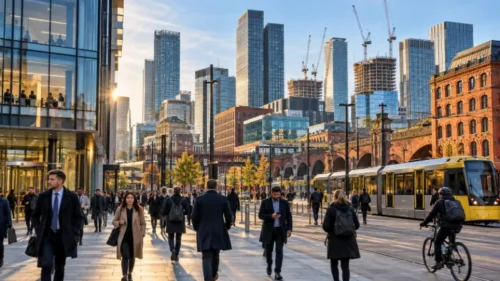
Manchester is one of the North West’s principal economic centres.
Its commercial importance developed through manufacturing and textile trading, but its modern economy is much more diverse.
Major sectors include professional services, finance, technology, digital media, education, healthcare, tourism and hospitality.
The city centre contains extensive office space and commercial activity, while surrounding metropolitan boroughs support industries such as logistics, advanced manufacturing and creative production.
Greater Manchester’s economy therefore operates across a much larger area than Manchester city alone.
Business and Professional Services
Manchester is an important location for accountancy, legal services, banking, consulting and other professional activities.
Businesses benefit from transport connections, universities and access to a large regional workforce.
Technology and Digital Industries
Digital businesses and technology companies operate throughout the region.
Universities, research institutions and commercial innovation programmes contribute to the development of new products and services.
Media and Creative Industries
The wider county has substantial media and creative activity.
MediaCity in Salford is particularly important, demonstrating how Greater Manchester’s economic identity extends beyond Manchester’s administrative boundary.
Education and Research
Universities and research institutions support employment, innovation and skills development.
This contributes to Manchester’s importance within the wider North West and national economy.
Does Manchester’s County Affect Postal Addresses?
Manchester’s modern county status does not normally require residents to include Greater Manchester in a postal address.
Royal Mail primarily relies on accurate address details and the correct postcode.
For example, a typical address might appear as:
Example Street
Manchester
M1 1AA
The example postcode is illustrative and should not be used as a verified delivery address.
A county name is generally unnecessary when the address and postcode are correct.
This means an address does not need to include Lancashire or Greater Manchester simply because of the city’s historical or administrative position.
However, some online forms still request a county.
For modern geographical classification, Greater Manchester is the appropriate county selection for addresses within the City of Manchester.
Residents should also remember that the M postcode area extends beyond Manchester City Council’s boundaries.
A Manchester postcode alone does not establish which local council administers a property.
Why Does Manchester’s County Identity Still Cause Confusion?
Manchester’s county identity can appear confusing because several overlapping geographical descriptions remain in use.
The most important differences are historical, ceremonial and administrative.
Historic Lancashire Identity
Manchester developed as a major Lancashire settlement long before Greater Manchester existed.
Many historical records and cultural references therefore continue to associate Manchester with Lancashire.
Greater Manchester’s Modern Boundaries
The county established in 1974 includes ten metropolitan districts.
It is much larger than the City of Manchester, creating confusion between the city and the metropolitan county.
Neighbouring Cities and Towns
Salford, Trafford, Stockport and other districts are frequently described as part of the Manchester area.
However, they remain separate local government areas.
Ceremonial and Administrative Differences
Greater Manchester continues to exist as a ceremonial county despite the abolition of its metropolitan county council in 1986.
Modern public administration is instead divided between the ten district councils and regional institutions.
A similar distinction exists in the capital, where London’s county status also involves separate ceremonial and local government structures.
These overlapping systems explain why older references, modern maps and everyday geographical descriptions may use different terms.
Conclusion
Manchester is in Greater Manchester, a metropolitan and ceremonial county in North West England.
Historically, Manchester was closely associated with Lancashire, but the creation of Greater Manchester on 1 April 1974 established its modern county position.
The City of Manchester is one of ten metropolitan boroughs and is governed locally by Manchester City Council.
Greater Manchester as a whole contains several neighbouring towns and cities, including Salford, Stockport, Bolton, Bury, Rochdale and Wigan.
The distinction is straightforward: Manchester is the city, Greater Manchester is the modern county, and Lancashire remains the principal historic county associated with Manchester’s development.
Understanding these differences makes it easier to interpret maps, historical records, council responsibilities and regional boundaries.
Frequently Asked Questions
Is Manchester in Lancashire or Greater Manchester?
Manchester is currently in Greater Manchester. Its historic city centre and much of its traditional urban area were historically in Lancashire before the 1974 local government reorganisation.
Is Manchester in the North West of England?
Yes. Manchester is located in North West England and is one of the region’s largest cities and principal economic centres.
Is Salford a Separate City From Manchester?
Yes. Salford is a separate city and metropolitan borough within Greater Manchester. It has its own local council despite sharing a continuous urban area with Manchester.
Is Old Trafford Stadium Actually in Manchester?
Old Trafford Stadium is in the Metropolitan Borough of Trafford, not within Manchester City Council’s boundary. It is nevertheless part of Greater Manchester.
Is Wigan Part of Greater Manchester?
Yes. Wigan is one of the ten metropolitan boroughs within Greater Manchester, although it is historically associated with Lancashire.
Does Greater Manchester Still Have a County Council?
No. Greater Manchester County Council was abolished in 1986. The county continues to exist, while local services are handled by metropolitan borough councils and certain regional functions are coordinated through the combined authority.
Is Manchester Airport Inside Greater Manchester?
Yes. Manchester Airport is within Greater Manchester and lies inside the City of Manchester’s administrative boundary, near its southern edge.
Is Greater Manchester the Same as the North West?
No. Greater Manchester is one county within North West England. The wider region also includes areas such as Lancashire, Merseyside, Cheshire and Cumbria.
What County Should Be Selected for a Manchester Address?
For a property within the City of Manchester, Greater Manchester is the correct modern ceremonial county. The actual local authority should be checked separately if a form asks for council details.
When Did Manchester Become Part of Greater Manchester?
Manchester became part of Greater Manchester on 1 April 1974, when the new metropolitan county was created under the Local Government Act 1972.