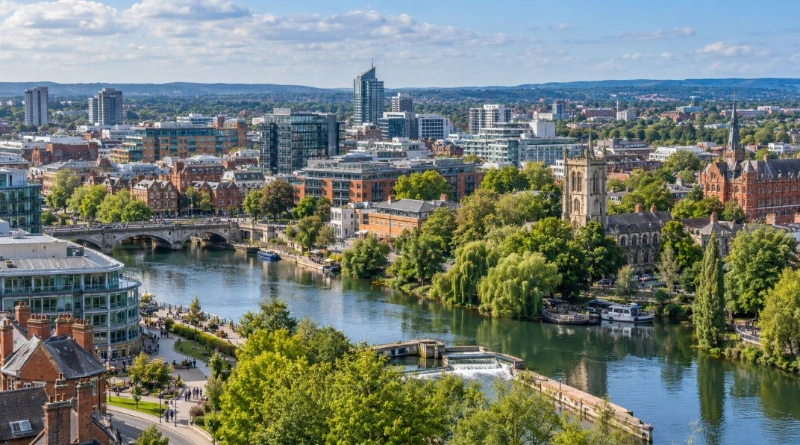
Reading is in Berkshire, England. More specifically, it is the county town of Berkshire, lies within the South East England region and is governed by Reading Borough Council, a unitary authority.
That simple answer can become confusing because Berkshire no longer has a county council, Reading provides its own local government services, and parts of modern Reading north of the River Thames were historically associated with Oxfordshire.
Reading is not a county and, despite its size and economic importance, it is not officially a city. It remains a town and borough with a particularly important role within the Royal County of Berkshire.
This article explains exactly what county Reading is in, where it sits on the UK map, how its administrative status works, why it became Berkshire’s county town and how Reading relates to nearby towns, counties and cities.
Where Exactly Is Reading Located in the UK?
It stands where the River Kennet meets the River Thames, a location that played an important role in Reading’s growth as a trading, industrial and transport centre.
Geographically, Reading belongs to South East England, not South West England.
Its location places the town between London and the western parts of southern England. Reading is also positioned on the important M4 and Great Western transport corridors connecting London with Swindon, Bristol and South Wales.
Key location facts include:
| Location Detail | Reading |
| Country | England |
| UK Region | South East England |
| Ceremonial County | Berkshire |
| County Town | Berkshire |
| Local Authority | Reading Borough Council |
| Main Rivers | Thames and Kennet |
| Postcode Area | RG |
| Telephone Code | 0118 |
| Approximate Distance From London | 40 miles west |
Reading is therefore firmly associated with Berkshire and the Thames Valley while maintaining particularly strong economic and transport links with London.
What County Is Reading In and Why Is It Significant?
Reading is in the ceremonial county of Berkshire, also formally known as the Royal County of Berkshire.
It is not simply another Berkshire town. Reading is recognised as the county town of Berkshire, giving it a long-standing civic and historical importance within the county.
Berkshire today includes six separate unitary authority areas rather than one county council. Reading is one of these authorities and controls its own major local government services.
Berkshire County Council was abolished in 1998 and its responsibilities were transferred to six unitary authorities, but Berkshire continued to exist as a ceremonial county.
The distinction between ceremonial counties, historic counties and council areas is important throughout England. Understanding how British counties and modern boundaries work makes Reading’s position considerably easier to understand.
Why Does Berkshire Matter to Reading?
Reading’s Berkshire identity matters for several reasons:
- Reading Is Berkshire’s County Town
- The Town Has Centuries of Berkshire History
- Reading Is One of the County’s Largest Economic Centres
- Major Berkshire Civic Institutions Are Based in Reading
- Reading Remains Within the Ceremonial Royal County
- The Town Is Closely Connected With West Berkshire, Wokingham and Other Berkshire Areas
Reading’s relationship with Berkshire is therefore historical, geographical, ceremonial and economic rather than simply postal.
Is Reading in Oxfordshire or Berkshire?
Reading is in Berkshire, not Oxfordshire.
However, there is an interesting historical reason why Oxfordshire can appear in discussions about Reading.
Most historic Reading developed south of the River Thames in Berkshire. Caversham, immediately north of the Thames, historically belonged to Oxfordshire.
Caversham became part of Reading in 1911, which also transferred the area into Berkshire.
This means a person researching Reading’s older geography may encounter both Berkshire and Oxfordshire.
Today, however, there is no ambiguity about the borough’s modern position.
Reading is in the ceremonial county of Berkshire.
What Type of County Is Berkshire for Reading?
Berkshire is primarily a ceremonial county under today’s local government system.
It no longer has one county council covering the entire county.
Instead, Berkshire is divided between six unitary authorities:
| Unitary Authority | Part of Ceremonial Berkshire? |
| Reading | Yes |
| West Berkshire | Yes |
| Wokingham | Yes |
| Bracknell Forest | Yes |
| Slough | Yes |
| Windsor and Maidenhead | Yes |
Each authority operates independently for most local government purposes.
The county nevertheless continues to have ceremonial institutions including a Lord-Lieutenant and High Sheriff.
Berkshire also holds the distinctive title Royal County of Berkshire, a designation formally recognised by Queen Elizabeth II in 1957 and later confirmed through Letters Patent in 1974.
Are There Other Places Called Reading?
Yes.
The best-known other Reading is Reading, Pennsylvania, in the United States. It is a completely separate place from Reading in Berkshire.
Search results, postal information and online maps may therefore distinguish the English town using terms such as:
- Reading, Berkshire
- Reading, England
- Reading, UK
The pronunciation of the English town is also worth remembering. Reading is pronounced “Redding”, rather than like the verb “reading”.
Is Reading a City, a County, or Both?
Reading is a town and borough, not a city and not a county.
Its size can make this surprising.
Reading is one of southern England’s major commercial and population centres and has characteristics often associated with cities, including a university, major railway station, large employment base, shopping district, professional football club and extensive urban area.
However, population and economic size do not automatically create city status in the United Kingdom.
Reading has unsuccessfully applied for city status on several occasions, including bids associated with:
- The Millennium in 2000
- Queen Elizabeth II’s Golden Jubilee in 2002
- The Diamond Jubilee in 2012
- The Platinum Jubilee in 2022
It therefore remains officially a town.
Reading is also not a county. Berkshire is the county.
The simplest description is:
Reading is a town, borough and unitary authority within the ceremonial county of Berkshire. It is also Berkshire’s county town.
Reading’s Geographical and Administrative Identity
Reading has several identities operating at the same time.
Geographically, it sits in the Thames Valley.
Regionally, it belongs to South East England.
Ceremonially, it is part of Berkshire.
Administratively, Reading Borough Council operates as an independent unitary authority.
Historically, Reading has been strongly associated with Berkshire for centuries, although Caversham’s former Oxfordshire identity adds an interesting exception north of the Thames.
Reading: Geographical and Administrative Profile 2026
| Attribute | Reading Information |
| Official Name | Reading |
| Settlement Status | Town |
| Borough Status | Yes |
| Country | England |
| Sovereign State | United Kingdom |
| Region | South East England |
| Ceremonial County | Berkshire |
| County Town | Berkshire |
| Local Government Type | Unitary authority |
| Governing Body | Reading Borough Council |
| Main Rivers | Thames and Kennet |
| Postcode Area | RG |
| Telephone Code | 0118 |
| 2021 Census Borough Population | Around 174,200 |
| Demonym | Redingensian |
| City Status | No |
Reading Borough Council continues to operate as the principal local authority for the borough and provides the functions that would otherwise be divided between county and district councils in two-tier areas.
A Brief History of Reading’s County and Governance
Reading’s connection with Berkshire stretches back many centuries. The settlement was known by the Anglo-Saxon period and was already sufficiently important to be recorded as a borough in the Domesday Book of 1086.
Reading Abbey was founded by Henry I in 1121 and transformed the town into an important religious, economic and political centre.
Following the dissolution of the monasteries, Reading increasingly developed its own civic institutions.
Important stages in its administrative development include:
| Period | What Happened? |
| 1086 | Reading was recorded as a borough in the Domesday Book |
| 1121 | Reading Abbey was founded by Henry I |
| 1253 | Reading’s merchant community secured an important royal charter |
| 1836 | Reading became a reformed municipal borough |
| 1869 | Reading was formally recognised as Berkshire’s sole county town |
| Late 19th Century | Reading became a county borough |
| 1911 | Caversham and other areas were incorporated into Reading |
| 1974 | Reading became a non-metropolitan district within Berkshire |
| 1998 | Reading Borough Council became a unitary authority |
The 1998 reforms are particularly important when answering what county Reading is in today. Berkshire County Council disappeared as an administrative organisation, but Berkshire itself did not disappear as a ceremonial and geographic county.
What Makes Reading the County Town of Berkshire?
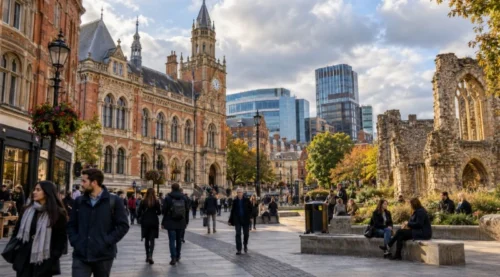
Reading’s position as Berkshire’s county town developed from its increasing administrative and economic importance.
Historically, Reading and Abingdon both performed county-related functions.
That position changed during the 19th century.
After Berkshire’s Summer Assizes were transferred from Abingdon to Reading in the 1860s, Reading was formally recognised as the sole county town in 1869.
Being a county town does not mean Reading governs all of Berkshire today.
Instead, the title reflects Reading’s historic role as an important centre for county administration, justice, commerce and public institutions.
That distinction matters.
Reading is Berkshire’s county town, but Reading Borough Council is not the council for the whole of Berkshire.
How Is Reading Governed Today?
Reading is governed by Reading Borough Council.
The council is a unitary authority, meaning it carries out the main local government responsibilities within its boundary without a separate Berkshire County Council above it.
Responsibilities include areas such as:
- Planning
- Housing
- Waste and Recycling
- Roads and Local Transport
- Adult Social Care
- Children’s Services
- Public Health
- Libraries
- Environmental Services
- Local Economic Development
Berkshire’s other five unitary councils have equivalent responsibilities within their own boundaries.
This structure has been in place since Berkshire County Council was abolished in 1998.
The county therefore remains geographically and ceremonially intact while local government operates through six separate authorities.
Will Reading’s Local Government Structure Change?
Reading’s position has been discussed during wider local government reorganisation in neighbouring areas.
One issue has involved Reading’s western urban boundary, particularly around Tilehurst.
Parts of the continuous Reading urban area fall within West Berkshire rather than Reading Borough Council, even though residents may regard themselves as living in the wider Reading area.
Reading Borough Council proposed transferring several neighbouring wards into Reading during the recent reorganisation process.
However, the government announced on 16 July 2026 that Reading’s requested boundary changes would not be agreed as part of those decisions. Reading therefore remains a separate unitary authority with its existing boundary.
This demonstrates why the difference between a built-up area and a council boundary matters.
The physical Reading urban area extends beyond the Borough of Reading itself.
Reading’s Wider Civic and Heritage Role
Reading continues to perform a wider civic role within Berkshire even though it does not govern the county.
Important institutions and functions based in or strongly associated with Reading include:
- Royal Berkshire Archives
- Crown and County Courts
- Major healthcare facilities
- University of Reading
- Important regional transport services
- Major employment centres
- Cultural and heritage organisations
Royal Berkshire Archives is particularly significant because it preserves records relating to the history of the wider county rather than Reading alone.
Top Things Reading Is Known For
Reading has a much broader identity than its county status.
Its history stretches from Anglo-Saxon England through medieval royal influence, industrialisation and modern technology.
1. Reading Abbey
Reading Abbey is one of the town’s most historically significant sites.
Henry I founded the abbey in 1121 and was later buried there.
The abbey became one of medieval England’s most important religious institutions and helped establish Reading as a centre for pilgrimage, trade and royal activity.
Although much of the complex disappeared following the Dissolution of the Monasteries, substantial ruins and the Abbey Gateway survive.
2. Reading Festival
Reading Festival is one of Britain’s best-known music festivals.
The event takes place during the August Bank Holiday weekend and has attracted major international musicians for decades.
Its national profile means Reading’s name is familiar even to people with little knowledge of the town’s geography.
3. University of Reading
The University of Reading is another major part of the town’s identity.
Its origins date to the late 19th century before it became an independent university in 1926.
Today, higher education contributes significantly to Reading’s population, research sector, employment market and international profile.
4. The Rivers Thames and Kennet
Reading developed around two important waterways.
The River Kennet flows through the town centre before joining the River Thames.
This position helped Reading develop historically as a trading centre and later connected it with the Kennet and Avon Canal system extending west towards Bath and Bristol.
The rivers continue to shape Reading’s landscape, recreation and neighbourhoods.
5. Beer, Biscuits and Bulbs
Reading’s industrial history is often summarised by the “Three Bs”:
- Beer
- Biscuits
- Bulbs
Brewing became a major local industry through businesses such as Simonds.
Huntley & Palmers made Reading internationally famous for biscuits.
Suttons Seeds developed another nationally important business in the town.
Although Reading’s economy has moved strongly towards technology and services, the Three Bs remain central to its industrial heritage.
6. The Oracle and Reading Town Centre
Reading is one of the Thames Valley’s most important shopping and commercial centres.
The Oracle shopping centre, Broad Street and surrounding streets form the heart of its retail district.
Reading’s relatively compact centre, major railway station and large employment base attract visitors and commuters from surrounding areas of Berkshire, Oxfordshire, Hampshire and beyond.
7. Reading Gaol and Oscar Wilde
Reading also has an important literary connection with Oscar Wilde.
Wilde was imprisoned in Reading Gaol from 1895 to 1897.
His experience eventually inspired The Ballad of Reading Gaol, making the site internationally recognised within literary history.
Reading has other literary associations too, including Jane Austen, who attended a school based in the Abbey Gateway during her childhood.
Reading Population in 2026: Growth and Demographics
There is no 2026 UK census, so a precise “2026 census population” should not be invented.
The most recent full census was carried out in 2021.
Reading’s borough population was approximately 174,200 at the 2021 Census.
More recent Reading Borough Council material used for current planning places the resident population higher. For example, its 2025–2030 tenant strategy gives a population figure of 178,196 residents, demonstrating continued growth since the census.
Reading Population Insights
| Measure | Figure or Description |
| 2001 Census Population | 143,096 |
| 2011 Census Population | 155,698 |
| 2021 Census Population | Around 174,200 |
| Current Council Planning Figure | 178,196 |
| Wider Urban Area | Extends beyond Reading Borough |
| Population Trend | Long-term growth |
| General Character | Younger and highly diverse urban population |
Population figures can differ considerably depending on whether a source measures:
- Reading Borough
- The Reading built-up area
- The wider Reading urban area
- The wider economic or travel-to-work area
This is why two reputable sources may publish different Reading population totals without necessarily contradicting each other.
Why Is Reading Important to Berkshire’s Identity?
Reading plays a central role in Berkshire because of its economic scale, transport network, population and historical importance.
1. Economic Strength
Reading is one of the Thames Valley’s major employment centres. Its economy has changed significantly from the industrial era.
The town was once strongly associated with brewing, biscuits, seed production and manufacturing.
Today, major sectors include:
- Technology
- Business Services
- Insurance
- Professional Services
- Retail
- Education
- Healthcare
Reading Borough Council describes Reading as the principal regional and commercial centre of the Thames Valley and highlights the presence of major technology and international businesses.
The town also has more jobs than resident workers, creating substantial inward commuting from neighbouring areas.
2. Cultural and Educational Influence
Reading’s influence extends beyond employment. The University of Reading attracts students and researchers from across Britain and internationally.
Reading Festival gives the town national cultural recognition. Historic sites such as Reading Abbey, Forbury Gardens, the Abbey Gateway and Reading Museum connect the modern town with centuries of Berkshire history.
These institutions help make Reading one of the county’s principal cultural centres.
3. Urban Growth and Development
Reading’s urban area extends beyond the council boundary. Places including Earley and Woodley lie in the wider continuous urban area but are administered by Wokingham Borough Council.
Western suburban development also reaches towards areas governed by West Berkshire Council. This creates a distinction between Reading the borough and Reading the wider urban area.
It also explains why Reading’s influence stretches far beyond the formal boundary shown on a council map.
What Are the Nearest Towns and Villages to Reading?
Reading is surrounded by a mixture of suburban towns, riverside communities and traditional Thames Valley settlements.
Distances below are approximate and can vary depending on the starting point and route.
1. Woodley – Around 4 Miles East
Woodley lies immediately east of Reading.
Although closely connected to Reading’s built-up area, Woodley is governed by Wokingham Borough Council rather than Reading Borough Council.
Its proximity makes it an important residential area for people working or studying in Reading.
2. Theale – Around 5 Miles Southwest
Theale lies west-southwest of Reading in West Berkshire.
It has road and railway connections with Reading and sits close to the M4 corridor.
The surrounding area includes business parks and residential communities closely connected with Reading’s economy.
3. Pangbourne – Around 6 Miles West
Pangbourne sits beside the River Thames west of Reading.
It is considerably smaller than Reading and has a more village-like character.
Rail services provide convenient access between Pangbourne and Reading.
4. Wokingham – Around 7 Miles Southeast
Wokingham is another major Berkshire town located southeast of Reading.
It has its own unitary authority and a separate town identity, although there are strong employment, transport and residential connections between the two areas.
Development around Earley, Winnersh and surrounding settlements means parts of the wider Reading-Wokingham area are increasingly interconnected.
5. Henley-on-Thames – Around 8 Miles Northeast
Henley-on-Thames lies northeast of Reading beside the Thames.
Unlike Reading, Henley is in Oxfordshire.
The close proximity of Henley and historic Oxfordshire connections around Caversham can contribute to occasional confusion about Reading’s county.
Reading itself nevertheless remains in Berkshire.
What Cities Are Close to Reading?
Reading does not have city status, but several recognised cities are within reach.
1. Oxford – Around 25 Miles North
Oxford is one of the closest cities to Reading.
The two places have strong connections through employment, higher education, technology and transport.
Despite their proximity, Oxford is in Oxfordshire while Reading is in Berkshire.
2. Winchester – Around 32 Miles South
Winchester lies south of Reading in Hampshire.
It is one of England’s most historically significant cathedral cities and was an important political centre during the Anglo-Saxon period.
Road connections through central Hampshire make Winchester relatively accessible from Reading.
3. London – Around 40 Miles East
London lies around 40 miles east of Reading geographically and has an enormous influence on Reading’s economy.
Fast rail services have made Reading an important location for commuters and businesses requiring access to the capital.
Their county identities are very different. Reading has the straightforward modern association of Berkshire, while London’s county status involves Greater London, the City of London and several historic county identities.
4. Southampton – Around 45 Miles South
Southampton lies on the Hampshire coast to the south of Reading.
It is an important port, university city and employment centre.
Rail and road routes provide connections between Reading and Southampton, helping link the Thames Valley with the south coast.
5. Bath – Around 70 Miles West
Bath lies considerably farther west but remains connected to Reading through the Great Western rail corridor.
Unlike Reading, which is in South East England, Bath is firmly associated with South West England.
The two places also share a historical connection through the Kennet and Avon Canal system.
How Well Connected Is Reading?
Transport is one of Reading’s strongest geographic advantages.
The town sits on major east-west and north-south routes and functions as an important regional transport interchange.
1. Road Network
The M4 motorway runs immediately south of Reading.
It provides connections east towards:
- Maidenhead
- Slough
- Heathrow
- London
Westbound routes provide access towards:
- Newbury
- Swindon
- Bristol
- South Wales
The A33 provides an important connection south towards Basingstoke and the wider Hampshire road network.
The A4 also passes through Reading and historically formed one of the principal routes between London and western England.
2. Rail and Elizabeth Line Connections
Reading railway station is one of the most important rail hubs outside London.
The town sits on the Great Western Main Line, with connections towards London Paddington, Oxford, Bristol, South Wales and the West Country.
Reading is also the western terminus of the Elizabeth line, significantly improving direct rail access across London.
Reading Borough Council describes the station as one of Britain’s busiest outside London and identifies the town as an important regional and national transport hub.
3. Public Transport
Reading has an extensive local bus network serving the town and surrounding communities.
Services connect central Reading with areas including:
- Caversham
- Tilehurst
- Woodley
- Earley
- University Areas
- South Reading
- Nearby Berkshire Settlements
The large volume of commuters travelling into Reading makes public transport particularly important.
4. Cycling and Walking
Reading’s relatively compact urban form makes walking and cycling practical for many shorter journeys.
Routes also follow sections of the Thames, Kennet and canal network.
The town connects with longer-distance cycle routes, allowing travel beyond the borough towards other Thames Valley communities.
5. Airports Near Reading
Reading does not have its own major commercial airport.
London Heathrow Airport is the nearest major international airport and lies east of Reading.
Reading’s location on the M4 corridor makes Heathrow particularly important for local businesses and international travel.
Other airports including Southampton and Gatwick can also be reached from Reading, although journey times are longer.
Why Is Reading’s County Often Confused?
The question “what county is Reading in?” appears simple, but several factors create confusion.
First, Berkshire County Council no longer exists.
Some people incorrectly assume that if there is no Berkshire County Council, Berkshire itself must no longer exist.
That is not the case.
Second, Reading is a unitary authority and provides its own major local services.
This can make Reading appear administratively separate from Berkshire even though it remains firmly within the ceremonial county.
Third, Caversham historically belonged to Oxfordshire before becoming part of Reading in 1911.
Fourth, the Reading urban area extends into neighbouring council areas such as Wokingham and West Berkshire.
Finally, modern postal addresses do not require traditional county names in the way they once did, which means “Reading, Berkshire” may not always appear on correspondence.
Conclusion
So, what county is Reading in? Reading is in Berkshire.
More precisely, Reading is a town, borough, unitary authority and the county town of the ceremonial Royal County of Berkshire in South East England.
The disappearance of Berkshire County Council in 1998 did not remove Reading from Berkshire. Instead, local government responsibilities were transferred to Reading Borough Council and Berkshire’s other unitary authorities.
Reading’s geography can appear complicated because the urban area crosses council boundaries and Caversham historically belonged to Oxfordshire. Neither factor changes Reading’s modern county position.
The town remains one of Berkshire’s most important economic, educational, cultural and transport centres.
Its location roughly 40 miles west of London, position on the M4 and Great Western Main Line, major university, commercial economy and extensive history have given Reading influence far beyond its borough boundary.
The straightforward answer remains the same: Reading is in Berkshire, England, and serves as Berkshire’s county town.
Frequently Asked Questions
What County Is Reading In?
Reading is in Berkshire, a ceremonial county in South East England. Reading is also recognised as Berkshire’s county town.
Is Reading in Berkshire or Oxfordshire?
Reading is in Berkshire. Caversham, now part of Reading, historically belonged to Oxfordshire until it was incorporated into Reading in 1911.
Is Reading a City?
No. Reading is officially a town and borough. It has applied for city status several times but has not been granted it.
Is Reading a County?
No. Reading is not a county. It is a unitary authority within the ceremonial county of Berkshire.
Is Reading in South East or South West England?
Reading is officially in South East England. Swindon, farther west along the M4, belongs to South West England.
Is Reading the County Town of Berkshire?
Yes. Reading became Berkshire’s sole county town during the 19th century and continues to hold that designation.
Why Does Berkshire Not Have a County Council?
Berkshire County Council was abolished in 1998. Local government responsibilities were transferred to six independent unitary authorities, including Reading.
What Is Reading Famous For?
Reading is known for Reading Festival, Reading Abbey, the University of Reading, its historic beer, biscuit and seed industries, its riverside location and its modern technology and business economy.
How Far Is Reading From London?
Reading is approximately 40 miles west of central London. Fast rail links and the Elizabeth line create strong connections between the two places.
What Is the Population of Reading?
The Borough of Reading recorded around 174,200 residents at the 2021 Census. More recent council planning material uses a figure of 178,196 residents, although totals vary depending on whether the borough or wider urban area is being measured.
Related Articles: