Newcastle upon Tyne is in the ceremonial county of Tyne and Wear, in North East England. Historically, however, Newcastle was part of Northumberland, which is why both county names can appear when researching the city.
The modern position is straightforward. Newcastle has been part of Tyne and Wear since local government reorganisation in 1974. The city is governed locally by Newcastle City Council as a metropolitan borough, while Tyne and Wear remains its ceremonial county.
Newcastle sits on the northern bank of the River Tyne, directly opposite Gateshead. It is the largest city in North East England and one of the main economic, cultural, educational and transport centres in the wider region.
So, for anyone asking what county is Newcastle in, the short answer is:
Newcastle upon Tyne is in Tyne and Wear. Its historic county is Northumberland.
Where Exactly Is Newcastle Located in the UK?
Gateshead lies immediately across the river to the south, with several bridges connecting the two urban centres. The surrounding built-up area forms part of Tyneside, one of the largest urban areas in northern England.
Newcastle sits roughly 46 miles south of the Scottish border and around 8 miles inland from the North Sea.
Its geographical position places it between the Northumberland countryside to the north and west and the more densely populated communities of Tyneside to the east and south.
In simple terms, Newcastle’s location can be described as:
- Country: England
- Region: North East England
- Ceremonial County: Tyne and Wear
- Historic County: Northumberland
- River: River Tyne
- Neighbouring Urban Area: Gateshead
The distinction between Tyne and Wear and Northumberland is particularly important because both names are strongly connected with Newcastle.
What County Is Newcastle In and Why Is It Significant?
Newcastle is in Tyne and Wear for modern ceremonial county purposes.
Tyne and Wear was created in 1974 and brought together several heavily urbanised communities around the rivers Tyne and Wear.
The county consists of five metropolitan boroughs:
| Metropolitan Borough | Main Centre |
| Newcastle upon Tyne | Newcastle |
| Gateshead | Gateshead |
| North Tyneside | Wallsend, North Shields and surrounding areas |
| South Tyneside | South Shields |
| Sunderland | Sunderland |
Newcastle is therefore not a separate modern county and is no longer considered part of Northumberland for current ceremonial geography.
However, historic county identity works differently. Newcastle developed within historic Northumberland and maintained a close relationship with the county for centuries.
Why Does Tyne and Wear Matter for Newcastle?
Tyne and Wear helps describe Newcastle’s modern geographical position within the wider Tyneside urban area.
The county links Newcastle with Gateshead, North Tyneside, South Tyneside and Sunderland, all of which have closely connected transport networks, employment markets and public services.
The county name also appears in organisations and services operating across the wider area.
However, Tyne and Wear does not function like a traditional two-tier county with one county council controlling Newcastle.
Newcastle City Council is responsible for local authority services within the city.
This distinction is important because the terms county, borough, city and local authority describe different things.
County Durham lies south of the wider Tyneside area.
Is Newcastle in Northumberland or Tyne and Wear?
Newcastle is currently in Tyne and Wear, but historically it was part of Northumberland.
This is the main reason different sources can appear to give conflicting answers.
Newcastle’s relationship with Northumberland stretches back centuries. The settlement was historically located within the county before receiving an increasingly independent civic and administrative identity.
In 1974, major changes to English local government created the metropolitan county of Tyne and Wear. Newcastle was included within the new county alongside Gateshead, Sunderland, North Tyneside and South Tyneside.
Therefore:
- For modern ceremonial geography, use Tyne and Wear
- For historic county geography, use Northumberland
- For local government, use Newcastle City Council
Newcastle has not returned to Northumberland simply because the former Tyne and Wear County Council no longer exists.
Similar county-boundary confusion occurs elsewhere in North East England. For example, Hartlepool’s position within County Durham also requires a distinction between ceremonial geography, historic boundaries and modern local government.
What Type of County Is Tyne and Wear?
Tyne and Wear is a metropolitan and ceremonial county. It was established on 1 April 1974 as part of a major reorganisation of English local government.
A county council initially operated across Tyne and Wear. However, the metropolitan county council system was abolished in 1986. That did not remove Tyne and Wear from the map.
Its five metropolitan boroughs became responsible for many of their own local government functions, while Tyne and Wear continued to exist as a ceremonial and geographical county.
This means a person can correctly say:
Newcastle is in Tyne and Wear, even though there is no Tyne and Wear County Council governing the city.
Are There Other Places Called Newcastle?
Yes. Newcastle upon Tyne is not the only place called Newcastle in the UK. The name can therefore cause confusion when somebody simply searches for “Newcastle”.
The two best-known examples are:
- Newcastle upon Tyne in Tyne and Wear
- Newcastle-under-Lyme in Staffordshire
There is also Newcastle in County Down, Northern Ireland.
When people in Britain refer simply to “Newcastle”, they most commonly mean Newcastle upon Tyne, particularly in discussions involving Newcastle United, the River Tyne, Geordies or North East England.
Is Newcastle a City, a County, or Both?
Newcastle upon Tyne is a city and metropolitan borough, not a county in its own right.
Newcastle received formal city status in 1882.
The wider local authority area is officially known as the City of Newcastle upon Tyne and includes the city centre as well as residential communities and suburbs surrounding it.
The distinction can be summarised simply:
| Term | Does It Apply to Newcastle? |
| City | Yes |
| Metropolitan Borough | Yes |
| Local Authority Area | Yes |
| Ceremonial County | No |
| Historic County | No |
| Separate Modern County | No |
| Part of Tyne and Wear | Yes |
| Historically Part of Northumberland | Yes |
Tyne and Wear is the ceremonial county.
Newcastle upon Tyne is one of the metropolitan boroughs within it.
Newcastle’s Geographical and Administrative Identity
Newcastle’s identity is easier to understand when geography and administration are separated. Geographically, the city occupies the northern side of the River Tyne and forms the central part of the wider Tyneside urban area.
Administratively, Newcastle City Council manages the metropolitan borough.
Historically, the city developed within Northumberland before centuries of civic independence and later local government reorganisation changed its formal position.
Newcastle Geographical and Administrative Profile 2026
| Detail | Newcastle Information |
| Official Name | Newcastle upon Tyne |
| Common Name | Newcastle |
| Settlement Type | City |
| Country | England |
| UK Region | North East England |
| Ceremonial County | Tyne and Wear |
| Historic County | Northumberland |
| Local Authority | Newcastle City Council |
| Authority Type | Metropolitan borough |
| Main River | River Tyne |
| Approximate Area | 115 km² |
| Latest 2025 Population Estimate | 320,838 |
| City Status | 1882 |
| Main Postcode Area | NE |
| Main Postcode Districts | NE1–NE7 and NE12–NE20 |
| Dialling Code | 0191 |
| Approximate Coordinates | 54.97°N, 1.61°W |
| Nearby Major Settlement | Gateshead |
The city’s residents are sometimes referred to formally as Novocastrians, although Geordie is the much more familiar cultural term associated with Newcastle and surrounding Tyneside communities.
A Brief History of Newcastle’s County and Governance
Newcastle’s county identity has changed as England’s local government system developed.
The city’s story began long before modern counties and councils.
The Romans established a settlement called Pons Aelius beside the River Tyne during the second century. Hadrian’s Wall also passed through the area.
After Roman rule ended, the settlement became associated with the Anglo-Saxon kingdom of Northumbria and was later known as Monkchester.
A major change came after the Norman Conquest.
Robert Curthose, the eldest son of William the Conqueror, established a castle in 1080. The “new castle” eventually provided the settlement with its modern name.
Newcastle became increasingly important as a commercial centre and defensive settlement close to the Scottish border.
A simplified timeline shows how its status developed:
| Period | What Happened? |
| Roman Era | Pons Aelius established beside the River Tyne |
| Anglo-Saxon Period | Settlement known as Monkchester |
| 1080 | Norman castle established |
| 1400 | Newcastle gained county corporate status |
| 1882 | Newcastle received city status |
| 1888 | Newcastle became a county borough |
| 1974 | Newcastle became part of Tyne and Wear |
| 1986 | Tyne and Wear County Council was abolished |
| Today | Newcastle remains in ceremonial Tyne and Wear and is governed by Newcastle City Council |
These changes explain why older maps and historical documents can describe Newcastle differently from modern sources.
Why Was Newcastle Historically Part of Northumberland?
Newcastle developed within the traditional boundaries of Northumberland.
Historically, Northumberland extended southwards to the River Tyne in this part of the region, while areas across the river around Gateshead belonged to historic County Durham.
The River Tyne therefore represented more than a physical divide between Newcastle and Gateshead. It also marked part of an important historic county boundary.
Newcastle gradually obtained considerable independence.
In 1400, Henry IV separated Newcastle from Northumberland for certain administrative purposes and established the County of the Town of Newcastle upon Tyne.
That unusual historic status gave Newcastle greater autonomy while its geographical and cultural connections with Northumberland remained strong.
The connection can still be seen today.
Travel north or west beyond Newcastle’s metropolitan boundary and you quickly enter modern Northumberland, including areas around Ponteland, Morpeth and Hexham.
Therefore, saying Newcastle has a strong Northumberland heritage is accurate.
Saying Newcastle is currently in the ceremonial county of Northumberland is not.
How Is Newcastle Governed Today?
Newcastle is governed locally by Newcastle City Council.
The council is responsible for major local services within the metropolitan borough, including areas such as planning, housing, social care, waste collection, environmental services and local infrastructure.
There is no modern Tyne and Wear County Council sitting above Newcastle City Council.
Newcastle also works with neighbouring councils on wider regional matters, particularly areas such as transport, investment, economic development and strategic infrastructure.
This creates several overlapping levels of identity:
- Newcastle is the city
- Newcastle upon Tyne is the metropolitan borough
- Newcastle City Council is the local authority
- Tyne and Wear is the ceremonial county
- North East England is the official English region
- Northumberland is Newcastle’s historic county
Once these definitions are separated, Newcastle’s county position becomes much easier to understand.
Top Things Newcastle Is Known For
Newcastle is known far beyond Tyne and Wear for its industrial history, architecture, football, nightlife, universities and River Tyne setting.
Several landmarks have become closely associated with the city’s identity.
1. Newcastle Castle
Newcastle Castle is directly connected with the city’s name. A Norman castle was established on the site in 1080, while much of the surviving stone keep dates from the 12th century.
The location had strategic importance long before the Normans arrived. The Romans had previously established Pons Aelius on nearby high ground overlooking an important crossing of the Tyne.
The castle therefore represents several different stages of Newcastle’s history within a relatively small area.
2. The Tyne Bridge and Quayside
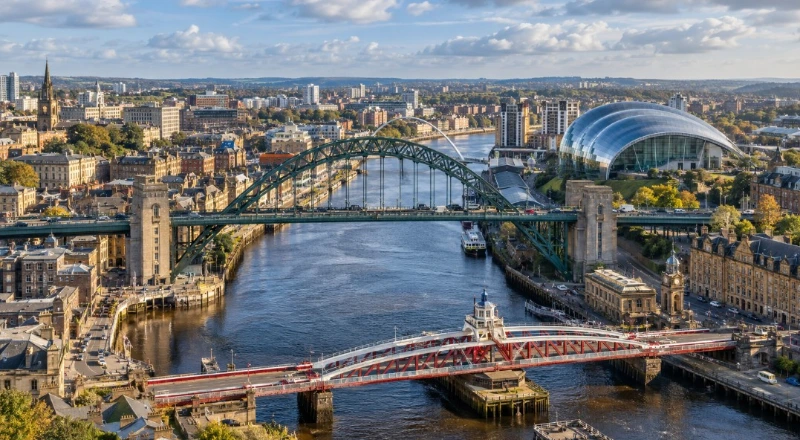
Few structures are more closely associated with Newcastle than the Tyne Bridge. Opened in 1928, the bridge connects Newcastle with Gateshead across the River Tyne.
The surrounding Quayside has changed considerably from its industrial past and is now one of the city’s most recognisable areas.
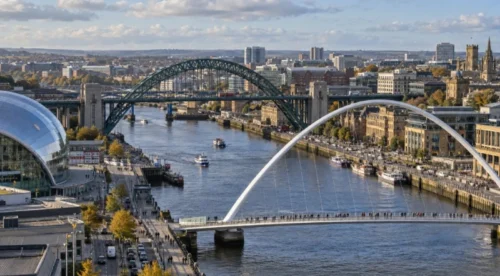
Historic buildings, bridges, restaurants and cultural venues line the river, while the nearby Gateshead Millennium Bridge provides another prominent connection between the two sides.
3. St James’ Park
St James’ Park is the home of Newcastle United Football Club and one of the most prominent landmarks in central Newcastle.
The club has played there since the 19th century, and the stadium’s location close to the heart of the city makes football particularly visible within Newcastle’s identity.
Newcastle United supporters are strongly associated with the black-and-white colours of the club, while match days bring large numbers of people into the city centre.
4. Grey Street and Grainger Town
Central Newcastle contains one of Britain’s best-known collections of neoclassical architecture.
Much of Grainger Town was developed during the 19th century by builder Richard Grainger alongside architect John Dobson.
Grey Street curves through this historic district and is particularly well known for its architecture.
Grey’s Monument stands near its northern end and commemorates Charles Grey, the former British prime minister associated with the Reform Act of 1832.
5. Newcastle Cathedral
Newcastle Cathedral, formally the Cathedral Church of St Nicholas, stands close to the Castle and Central Station.
Parts of the present building date from the medieval period, while its distinctive lantern tower has long been a recognisable feature of Newcastle’s skyline.
The cathedral became the seat of the newly created Diocese of Newcastle during the 19th century.
6. Great North Museum: Hancock
The Great North Museum: Hancock contains collections covering archaeology, natural history and world cultures.
Its Roman collections are especially relevant to Newcastle because of the city’s position along Hadrian’s Wall and its origins as Pons Aelius.
The museum also reflects Newcastle’s importance as a university and cultural centre.
7. Ouseburn and the Victoria Tunnel
Ouseburn lies east of Newcastle city centre and has developed into an important creative and cultural district.
The area retains visible reminders of the city’s industrial history alongside music venues, studios, independent businesses and cultural organisations.
Nearby, the Victoria Tunnel was constructed during the 19th century to transport coal towards the River Tyne. It was later used as an air-raid shelter during the Second World War.
Visitors spending more than a day exploring these areas can find hotels in Newcastle across the city centre, Quayside and surrounding districts.
Newcastle Population in 2026: Latest Official Figure

As of 2026, the latest available official population estimate for the Newcastle upon Tyne local authority area relates to mid-2025.
That estimate places Newcastle’s population at approximately 320,838 people.
A final official mid-2026 population estimate is not yet available, so describing 320,838 as Newcastle’s “2026 population” would be misleading.
It is more accurate to say:
Newcastle had an estimated population of 320,838 in mid-2025, the latest official estimate available during 2026.
It is also important to check which Newcastle area a population figure represents.
| Population Term | What It Refers To |
| Newcastle upon Tyne Metropolitan Borough | Newcastle City Council’s entire local authority area |
| Newcastle Urban Area | Continuously developed parts of Newcastle |
| Tyneside | Much larger urban area including communities beyond Newcastle |
| Tyne and Wear | Entire ceremonial county |
A population figure for Tyneside should therefore not be presented as the population of Newcastle city itself.
This distinction is particularly important when comparing Newcastle with other UK cities.
Why Is Newcastle Important to Tyne and Wear?
Newcastle has an important role within Tyne and Wear and across North East England.
Its influence extends well beyond the formal city boundary because thousands of people travel into Newcastle for employment, education, shopping, entertainment, healthcare and transport.
1. Economic Importance
Historically, Newcastle’s economy was closely linked to coal, engineering, shipbuilding and maritime trade.
Coal from the surrounding region travelled through Newcastle and the River Tyne for centuries.
The Industrial Revolution significantly expanded manufacturing, engineering and shipbuilding along Tyneside.
Newcastle’s modern economy is much more diversified.
Important sectors now include:
- Professional services
- Finance
- Digital and technology businesses
- Healthcare
- Higher education
- Retail
- Hospitality
- Creative industries
- Tourism
The city centre also serves as one of the main commercial and employment centres for the wider North East.
2. Education and Cultural Influence
Newcastle has two major universities, Newcastle University and Northumbria University. Students from across the UK and overseas contribute significantly to the city’s population, economy and cultural life.
Newcastle also supports major theatres, galleries, museums, music venues and heritage attractions. Its cultural influence extends across the River Tyne into Gateshead, where major venues form part of the same wider urban cultural landscape.
3. Regional Transport and Connectivity
Newcastle is one of the most important transport centres in northern England. Newcastle Central Station sits on the East Coast Main Line, providing direct rail connections towards London, York and Edinburgh.
The Tyne and Wear Metro links Newcastle with Gateshead, Sunderland, North Tyneside, the coast and Newcastle International Airport.
Road connections also provide access towards Scotland, Cumbria, Yorkshire and other parts of the North East.
Newcastle consequently functions as a transport hub not just for Tyne and Wear but for a much larger part of northern England.
What Are the Nearest Towns and Places to Newcastle?
Newcastle forms part of a continuous urban area, so some neighbouring communities can feel like extensions of the city even though they belong to separate local authorities.
Distances below are approximate and can vary depending on the starting point and route.
1. Gateshead – Immediately South
Gateshead lies directly across the River Tyne from Newcastle city centre.
The two centres are connected by several bridges and function as closely linked parts of the same urban area.
However, they have different historic county identities.
Newcastle was historically associated with Northumberland, while Gateshead historically belonged to County Durham.
Both are now within ceremonial Tyne and Wear.
2. Wallsend – Around 4 Miles East
Wallsend lies east of Newcastle within North Tyneside.
Its name comes from its location near the eastern end of Hadrian’s Wall.
Segedunum Roman Fort marks the wall’s eastern terminus and provides an important connection with the Roman history that also runs through Newcastle.
3. Tynemouth – Around 9 Miles East
Tynemouth lies near the mouth of the River Tyne on the North Sea coast.
It forms part of North Tyneside and is known for Tynemouth Priory, beaches and its coastal setting.
The Tyne and Wear Metro provides convenient connections between central Newcastle and Tynemouth.
4. Ponteland – Around 8 Miles Northwest
Ponteland lies northwest of Newcastle and, unlike Gateshead, Wallsend and Tynemouth, is within Northumberland.
Its proximity helps explain how quickly travellers leaving Newcastle to the north-west can cross from Tyne and Wear into modern Northumberland.
Newcastle International Airport is located between the city and Ponteland.
5. Whitley Bay – Around 10 Miles East
Whitley Bay is another major coastal settlement within North Tyneside.
Its beach, promenade and nearby St Mary’s Lighthouse make it a popular coastal destination for people travelling from Newcastle.
Metro connections allow people to travel between the city centre and the coast without using a car.
What Cities Are Close to Newcastle?
Newcastle’s location provides relatively easy access to several other cities across North East England and beyond.
1. Sunderland – Around 13 Miles Southeast
Sunderland is the nearest major city to Newcastle.
Both cities are within ceremonial Tyne and Wear and are connected through road, rail and Metro services.
Despite their proximity, Newcastle and Sunderland have distinct civic identities and a long sporting rivalry.
2. Durham – Around 18 Miles South
Durham lies south of Newcastle in County Durham.
The city is internationally known for Durham Cathedral and Durham Castle, which form part of a UNESCO World Heritage Site.
Rail services make the journey between Newcastle and Durham particularly convenient.
3. Carlisle – Around 60 Miles West
Carlisle lies west of Newcastle in Cumbria.
The A69 provides the main road corridor between the two cities, crossing northern England close to the route of Hadrian’s Wall.
Rail services also link Newcastle and Carlisle through the Tyne Valley.
4. York – Around 80 Miles South
York lies south of Newcastle in North Yorkshire.
Both cities are situated on the East Coast Main Line, allowing relatively fast rail travel between them.
York is particularly known for York Minster, its medieval city walls and historic centre.
5. Edinburgh – Around 105 Miles North
Edinburgh is further north across the Scottish border.
Direct trains run between Newcastle and Edinburgh along the East Coast Main Line, making the Scottish capital one of Newcastle’s most important northern rail connections.
Newcastle’s proximity to Scotland is one reason the city historically held such strategic importance.
The wider North East contains several other places where modern and historic county boundaries differ. Further south, Middlesbrough’s county position is another example of how traditional county identity and modern administrative geography can overlap.
How Well Connected Is Newcastle?
Newcastle is well connected by road, rail, Metro, bus and air.
Its transport network serves both the city itself and a much larger population across Tyne and Wear, Northumberland and County Durham.
1. Road Network
The A1 is the principal long-distance road serving the Newcastle area.
It provides routes north towards Northumberland and Scotland and south towards Durham, Yorkshire and the rest of England.
The A69 runs westwards towards Hexham and Carlisle.
Other major urban roads connect Newcastle with Gateshead, North Tyneside and surrounding communities.
2. Rail Connections
Newcastle Central Station is one of the most important railway stations in North East England.
It sits on the East Coast Main Line and offers direct or convenient connections to destinations including:
- London
- Edinburgh
- York
- Durham
- Leeds
- Birmingham
- Manchester
- Carlisle
Its city-centre location means many major attractions, shopping areas and employment districts are within walking distance.
3. Tyne and Wear Metro
The Tyne and Wear Metro forms a central part of public transport across the urban area.
Services connect Newcastle city centre with destinations including:
- Gateshead
- Sunderland
- North Shields
- Tynemouth
- Whitley Bay
- South Shields
- Newcastle International Airport
The Metro is particularly useful for understanding Newcastle’s relationship with the wider county because it physically links communities across several Tyne and Wear boroughs.
4. Buses, Walking and Cycling
Newcastle has extensive local bus services connecting the centre with suburban areas and neighbouring communities.
Much of the central city is also relatively compact.
Locations such as Newcastle Central Station, Grainger Town, Grey Street, St James’ Park, Newcastle Castle and the Quayside can be reached on foot from the centre.
Walking and cycling routes along the River Tyne provide further links towards Ouseburn and neighbouring districts.
5. Newcastle International Airport
Newcastle International Airport lies approximately six miles northwest of the city centre.
The airport serves domestic and international destinations and is directly connected with central Newcastle by the Tyne and Wear Metro.
Its position close to the boundary with Northumberland also demonstrates Newcastle’s geographical location near the northern edge of Tyne and Wear.
Conclusion
Newcastle upon Tyne is in Tyne and Wear, in North East England. Although the city was historically part of Northumberland, it has officially been part of Tyne and Wear since 1974.
Today, Newcastle is governed by Newcastle City Council and remains one of the main cities in the North East. Its location on the River Tyne, close to Gateshead, Northumberland and the North Sea, has helped shape its history, economy and identity.
So, if someone asks what county is Newcastle in, the simple answer is Tyne and Wear. Northumberland is only relevant when talking about Newcastle’s historic county connection.
FAQs
What County Is Newcastle Upon Tyne In?
Newcastle upon Tyne is in the ceremonial county of Tyne and Wear in North East England. Its historic county is Northumberland.
Is Newcastle in Northumberland?
Newcastle is historically associated with Northumberland, but its present ceremonial county is Tyne and Wear. Modern Northumberland begins beyond parts of Newcastle’s metropolitan boundary.
Is Newcastle in Tyne and Wear?
Yes. Newcastle has been part of Tyne and Wear since the metropolitan county was created in 1974.
Is Newcastle a County?
No. Newcastle is a city and metropolitan borough. It forms part of the ceremonial county of Tyne and Wear.
Is Newcastle in County Durham?
No. Newcastle is in Tyne and Wear. Gateshead, immediately south of Newcastle across the River Tyne, was historically part of County Durham.
Is Newcastle in North East England?
Yes. Newcastle is one of the principal cities of North East England and serves as a major economic, educational, cultural and transport centre for the region.
What Is the Difference Between Newcastle and Newcastle upon Tyne?
They normally refer to the same city. Newcastle upon Tyne is the full official name, while Newcastle is the commonly used shortened form.
What Is Newcastle’s Historic County?
Newcastle’s historic county is Northumberland, although the city gained considerable administrative independence from the county centuries ago.
Does Tyne and Wear Still Exist?
Yes. Tyne and Wear continues to exist as a ceremonial and metropolitan county even though the former Tyne and Wear County Council was abolished in 1986.
What Is the Population of Newcastle in 2026?
The latest official estimate available during 2026 places the population of the Newcastle upon Tyne local authority area at approximately 320,838 in mid-2025. An official mid-2026 estimate is not yet available.