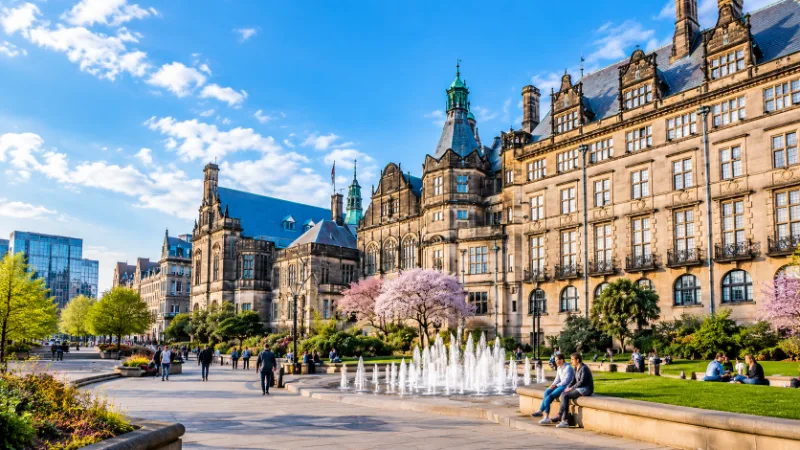
Sheffield is in South Yorkshire, a metropolitan and ceremonial county in northern England. It is also part of the wider Yorkshire and the Humber region and has strong historical connections with the West Riding of Yorkshire.
This is why Sheffield can be described as being in both South Yorkshire and Yorkshire. South Yorkshire is the correct modern county, while Yorkshire reflects the city’s broader historic and cultural identity.
South Yorkshire includes Sheffield, Barnsley, Rotherham and Doncaster.
Since the county was created in 1974, it has undergone major economic, industrial and administrative changes, moving from an economy heavily dependent on coal and traditional steelmaking towards advanced manufacturing, research, technology, education and regional investment.
Why Is Sheffield Located In South Yorkshire?
Sheffield became part of South Yorkshire when the metropolitan county was officially created on 1 April 1974 under the Local Government Act 1972.
Before this change, Sheffield was historically associated with the West Riding of Yorkshire.
The new county brought together Sheffield, Barnsley, Doncaster and Rotherham, areas that already had strong economic and social connections through coal mining, steelmaking, manufacturing, railways and commuting.
Today, Sheffield remains one of South Yorkshire’s four metropolitan districts.
The city sits near the southern and western edge of the county. Rotherham lies immediately to the east and north-east, Barnsley is to the north, while Derbyshire begins to the south and west.
This creates some geographic confusion because settlements only a short distance apart can belong to different counties. One clear example is Chesterfield in Derbyshire, which lies south of Sheffield but is outside South Yorkshire.
Is Sheffield In South Yorkshire Or Yorkshire?
Sheffield can correctly be associated with both South Yorkshire and Yorkshire, but the terms describe different geographic levels.
South Yorkshire is Sheffield’s present-day metropolitan and ceremonial county.
Yorkshire is the much larger historic county and cultural region from which South Yorkshire developed.
Historically, Sheffield belonged mainly to the West Riding of Yorkshire. When local government boundaries changed in 1974, Sheffield became part of the newly formed South Yorkshire metropolitan county.
The creation of South Yorkshire did not remove Sheffield’s Yorkshire identity.
This means someone may describe Sheffield as being in Yorkshire when talking about culture, history or the wider region, while South Yorkshire is the more precise answer for modern county geography.
Similar distinctions exist elsewhere in England, where modern metropolitan counties do not always match historic county boundaries. The history of Manchester’s county location is another example of how administrative geography has changed over time.
When Did Sheffield Become Part Of South Yorkshire?
Sheffield became part of South Yorkshire on 1 April 1974.
The Local Government Act 1972 reorganised local government across England and Wales and created several new metropolitan counties.
South Yorkshire was one of them.
Before 1974, Sheffield operated as a county borough and had long-standing links with the West Riding of Yorkshire.
When South Yorkshire was established, local government operated through two levels.
- South Yorkshire County Council: Managed county-wide functions
- Sheffield City Council: Managed local services within Sheffield
- Barnsley Council: Managed services within Barnsley
- Doncaster Council: Managed services within Doncaster
- Rotherham Council: Managed services within Rotherham
South Yorkshire County Council was abolished in 1986.
However, South Yorkshire itself did not disappear. It continues to exist as both a metropolitan county and ceremonial county.
The four metropolitan councils now handle most local government services, while some wider regional responsibilities are coordinated through the South Yorkshire Mayoral Combined Authority.
What Were The Biggest Historical Changes That Shaped South Yorkshire?
South Yorkshire has been shaped by several major periods of economic and social change.
The Industrial Revolution was perhaps the most important.
Sheffield developed into one of the world’s best-known centres for steel production, metalworking and cutlery. At the same time, coal mining expanded across Barnsley, Doncaster, Rotherham and surrounding areas.
Railway development also changed the county significantly.
Rail networks allowed coal, steel and manufactured goods to move quickly across Britain, helping South Yorkshire grow into a major industrial region.
During the nineteenth and twentieth centuries, entire communities developed around mines, steelworks and factories.
The decline of these industries later had an equally significant impact.
Coal mine closures and reductions in traditional steel production resulted in job losses, economic restructuring and the need for large-scale regeneration.
The county has since moved towards a more diversified economy based on advanced manufacturing, research, education, healthcare, technology, logistics and professional services.
How Did The Industrial Revolution Transform Sheffield And South Yorkshire?
The Industrial Revolution transformed Sheffield from a regional manufacturing centre into an internationally recognised industrial city.
Sheffield already had a long history of metalworking, but advances in steel production allowed manufacturing to expand rapidly.
Factories, workshops and industrial neighbourhoods grew around the city.
Steel from Sheffield became associated with specialist tools, engineering products, cutlery and other high-quality manufactured goods.
Coal was equally important across the wider county.
Large mining communities developed around Barnsley, Doncaster and Rotherham, providing fuel for factories, transport and homes.
The growth of industry also accelerated population growth.
Workers moved into South Yorkshire to find employment agencies, leading to the expansion of towns, housing, railways, roads and public infrastructure.
Many elements of South Yorkshire’s identity today can still be traced back to this industrial period.
How Did The Decline Of Coal Mining And Traditional Steelmaking Affect The County?
The decline of coal mining and traditional steel production had one of the biggest economic impacts in South Yorkshire’s modern history.
For generations, many communities depended directly on mines, steelworks and associated engineering companies.
When pits closed and heavy industry contracted, thousands of jobs disappeared.
The effect extended far beyond individual workplaces.
Local shops, transport providers, suppliers and service businesses were also affected because they relied on industrial employment and spending.
Former mining communities faced long-term challenges including unemployment, reduced investment opportunities and fewer local job opportunities.
Sheffield also experienced major industrial restructuring.
Steel production did not disappear, but the industry became more specialised and focused increasingly on high-value products, research and advanced engineering.
Recovery therefore required investment in new industries as well as the redevelopment of former industrial sites.
How Has South Yorkshire Recovered And Improved Since Industrial Decline?
South Yorkshire’s recovery has taken place gradually over several decades.
Instead of depending on a small number of traditional industries, the regional economy has become more varied.
Important areas of growth include:
- Advanced Manufacturing: Building on South Yorkshire’s existing engineering expertise
- Digital Technology: Supporting technology and software businesses
- Higher Education: Creating research, innovation and skilled employment
- Healthcare: Providing major employment and research opportunities
- Logistics: Using South Yorkshire’s central location and transport connections
- Professional Services: Expanding office-based employment
- Regeneration: Bringing former industrial and underused land back into productive use
Sheffield has become particularly important for research-led manufacturing.
Rotherham has also developed significant advanced manufacturing activity, while Doncaster has strengthened its position in logistics and transport.
Barnsley has seen town-centre regeneration, small business investment and redevelopment of former industrial areas.
South Yorkshire has therefore not abandoned its industrial history. Instead, much of its modern economy has developed from skills that already existed within the region.
What Major Developments Have Had The Biggest Impact On South Yorkshire?
Several modern developments have influenced South Yorkshire’s economy and quality of life.
One has been the growth of research-led advanced manufacturing.
Facilities around Sheffield and Rotherham have brought universities, researchers and major manufacturers together to develop new materials, production systems and engineering techniques.
Transport investment has also been significant.
Sheffield’s Supertram system has provided an important public transport network since the 1990s. In March 2024, operation of the tram network returned to public control through the South Yorkshire Mayoral Combined Authority.
Regional governance has changed as well.
From the 2026/27 financial year, South Yorkshire became one of the English mayoral authorities receiving an Integrated Settlement. This brings several government funding streams together and provides greater flexibility over regional investment.
Another important change came in September 2026 with the launch of the South Yorkshire Strategy, which sets long-term regional ambitions around opportunity, health, communities, housing, connectivity, place and sustainability.
How Has Advanced Manufacturing Changed South Yorkshire’s Economy?
Advanced manufacturing has become one of South Yorkshire’s strongest modern economic sectors.
It builds directly on the county’s history of steelmaking, engineering and specialist manufacturing while using new technologies and research.
Modern manufacturing in the region increasingly involves:
- Advanced Materials
- Automation
- Robotics
- Aerospace Engineering
- Precision Manufacturing
- Digital Production
- Low-Carbon Technology
Universities and research centres have played an important role in this transition.
Rather than producing large quantities of basic industrial goods, many modern manufacturers focus on highly specialised components, materials and engineering solutions.
This shift has allowed South Yorkshire to retain a strong manufacturing identity while adapting to technological change.
Sheffield is particularly important to this transformation because its industrial history, universities and engineering research facilities create links between traditional skills and emerging industries.
What Recent Governance And Devolution Changes Have Affected South Yorkshire?
Devolution has changed how major regional decisions are made in South Yorkshire.
The South Yorkshire Mayoral Combined Authority coordinates selected responsibilities across Sheffield, Barnsley, Doncaster and Rotherham.
The government identifies South Yorkshire as an Established Mayoral Strategic Authority. Its constituent councils remain responsible for local services, while the combined authority works on issues that affect the wider region.
From April 2026, South Yorkshire began delivering its Integrated Settlement.
The settlement covers several funding areas and is designed to give the region greater flexibility over how money is used for priorities such as transport, economic development, housing and regeneration.
This does not mean Sheffield City Council has been replaced.
Instead, South Yorkshire now has stronger regional coordination alongside its existing local councils.
What Impact Has The South Yorkshire Mayoral Combined Authority Had?
The South Yorkshire Mayoral Combined Authority has increased cooperation between the county’s four metropolitan districts.
Its constituent councils are:
- Barnsley
- Doncaster
- Rotherham
- Sheffield
The authority works across areas including transport, economic growth, skills, housing, infrastructure and investment.
Its regional approach can be particularly useful for issues that do not stop at council boundaries.
Public transport is one example.
People regularly travel between Sheffield, Rotherham, Barnsley and Doncaster for work, education and leisure, meaning transport planning often needs to consider the county as a wider economic area.
The Integrated Settlement introduced from April 2026 has expanded the authority’s ability to coordinate funding across different policy areas.
The combined authority has therefore become an increasingly important part of South Yorkshire’s modern governance structure.
What Makes South Yorkshire Different From Other English Counties?
South Yorkshire differs from many traditional English counties because it was created specifically as a metropolitan county.
It contains four closely connected metropolitan districts rather than being organised primarily around rural districts and a conventional county council.
Its industrial history is another major difference.
Few areas of England became as closely associated with steel, mining and engineering as South Yorkshire.
Yet the county is not entirely urban.
Western Sheffield reaches into the Peak District, while substantial countryside can also be found around Barnsley, Doncaster and other parts of the county.
This creates an unusual combination of:
- Large Urban Centres
- Former Mining Communities
- Industrial Landscapes
- Advanced Manufacturing Districts
- Universities And Research Centres
- Open Countryside
- National Park Landscapes
Visitors exploring the city itself can also find a much wider mix of museums, green spaces and cultural attractions among the things to do in Sheffield, showing how far the city has moved beyond its old image as purely an industrial centre.
What Is Unique About South Yorkshire Compared With The Rest Of Yorkshire?
Yorkshire is a large historic region with very different landscapes and economies.
South Yorkshire stands out because of the concentration of communities shaped by heavy industry.
Sheffield became internationally associated with steel and specialist metalworking.
Barnsley developed strong connections with coal mining.
Rotherham became important for steel, manufacturing and engineering.
Doncaster developed through mining, railways, transport and logistics.
Other parts of Yorkshire developed differently.
North Yorkshire contains large rural areas and national parks, while the East Riding includes extensive agricultural landscapes and coastal settlements.
West Yorkshire contains major cities such as Leeds and Bradford but developed around a different mixture of textiles, manufacturing, commerce and financial services.
South Yorkshire’s defining characteristic is therefore the way its industrial heritage has evolved into modern engineering and advanced manufacturing.
How Has Sheffield’s Role Within South Yorkshire Changed Over Time?
Sheffield has long been the largest urban centre in South Yorkshire.
Historically, its influence came from manufacturing.
Steelmaking, engineering, cutlery production and related industries gave Sheffield an international reputation.
Today, the city’s role is much broader.
Sheffield now supports major employment in:
- Advanced Manufacturing
- Healthcare
- Higher Education
- Research
- Technology
- Digital Industries
- Professional Services
- Retail
- Tourism And Culture
Its universities also contribute to research and attract students from Britain and overseas.
Sheffield continues to function as an important gateway for visitors exploring South Yorkshire and the Peak District. Its established visitor economy is reflected in the range of hotels in Sheffield serving business travellers, students, tourists and people attending events in the city.
Sheffield therefore remains central to South Yorkshire economically, culturally and administratively.
Was Sheffield Historically Part Of The West Riding Of Yorkshire?
Yes. Sheffield was historically associated principally with the West Riding of Yorkshire.
Yorkshire was traditionally divided into three historic ridings:
- East Riding
- North Riding
- West Riding
The historic West Riding covered a much larger area than the modern metropolitan county called West Yorkshire.
The two should not be confused.
Sheffield, Barnsley and other areas that are now within South Yorkshire historically belonged to the West Riding.
When local government boundaries changed in 1974, much of this southern part of the historic West Riding became part of the newly created South Yorkshire.
This explains why Sheffield retains such a strong Yorkshire identity despite South Yorkshire being its modern county.
Which Counties And Areas Border Sheffield?
Sheffield lies close to South Yorkshire’s southern and western boundaries.
Its neighbouring areas include:
- Rotherham: East and north-east
- Barnsley: North
- Derbyshire: South and west
Derbyshire is particularly important because the boundary lies close to Sheffield’s urban area.
People can travel only a relatively short distance south from Sheffield before crossing into Derbyshire.
This also explains why Sheffield has strong connections with places such as Chesterfield and parts of the Peak District.
The relationship between Sheffield and Derbyshire is geographical, economic and practical. Many people travel between the areas for work, shopping, education and recreation.
However, Sheffield itself remains firmly within South Yorkshire.
How Is Sheffield Governed In 2026?
Sheffield is governed locally by Sheffield City Council.
There is no active South Yorkshire County Council.
Instead, South Yorkshire’s four metropolitan district councils provide most local government services within their own areas.
For Sheffield, this means Sheffield City Council remains responsible for major local functions.
At the wider regional level, the South Yorkshire Mayoral Combined Authority coordinates selected strategic responsibilities across all four districts.
The structure can be understood as:
- Sheffield City Council: Local government within Sheffield
- South Yorkshire Mayoral Combined Authority: Selected strategic responsibilities across the wider South Yorkshire area
The government currently classifies South Yorkshire as an Established Mayoral Strategic Authority, with Barnsley, Doncaster, Rotherham and Sheffield as its constituent councils.
The 2026 Integrated Settlement has further increased the importance of this regional layer by bringing multiple funding streams into a more coordinated system.
How Does Sheffield Relate To The Peak District?
Sheffield has an unusually close relationship with the Peak District National Park.
Part of the western Sheffield local authority area extends into the national park.
This means the landscape changes significantly across the city.
Central and eastern Sheffield have a more urban character shaped by housing, industry and commercial development.
Travel west and the environment becomes increasingly rural, with valleys, woodland, reservoirs and moorland.
The Peak District also forms an important geographical connection between Sheffield and neighbouring Derbyshire.
This access to countryside is one of the features that distinguishes Sheffield from many other large English cities.
It allows residents to live within a major urban centre while remaining relatively close to national park landscapes.
What Are The Biggest Challenges Still Facing South Yorkshire?
South Yorkshire has made considerable progress since the decline of traditional heavy industry, but several long-term challenges remain.
Skills And Employment
Modern manufacturing and technology industries require increasingly specialised skills. Training residents for these jobs remains important.
Transport
Improving connections between communities can make employment, education and public services easier to access.
Health Inequalities
Different communities within South Yorkshire experience different health outcomes, making public health one of the region’s long-term priorities.
Housing And Regeneration
Some neighbourhoods continue to need investment in housing quality, town centres and public spaces.
Productivity
Increasing business investment and economic productivity remains important if South Yorkshire is to close economic gaps with stronger-performing regions.
Opportunity
One of the key challenges is ensuring that economic development benefits communities across Sheffield, Barnsley, Doncaster and Rotherham rather than being concentrated in a limited number of areas.
The South Yorkshire Strategy launched in September 2026 places opportunity, health, housing, communities and connections among its central priorities.
Conclusion
Sheffield is in South Yorkshire, a metropolitan and ceremonial county in northern England.
Its historic connection with the West Riding of Yorkshire explains why Sheffield continues to be strongly associated with the wider Yorkshire identity.
South Yorkshire has undergone significant change since it was created in 1974.
Coal mining, steelmaking and engineering shaped its growth, while the later decline of traditional industry created major economic challenges.
Today, the county increasingly relies on advanced manufacturing, research, universities, technology, logistics and regeneration.
Governance has changed too, with greater devolution and the South Yorkshire Mayoral Combined Authority giving the region more responsibility for strategic planning and investment.
Sheffield remains central to this story, combining a strong industrial heritage with an increasingly diverse modern economy.
FAQs
Is Sheffield Part Of Yorkshire?
Yes. Sheffield is historically and culturally part of Yorkshire. Its modern metropolitan and ceremonial county is South Yorkshire.
Is Sheffield In South Yorkshire Or West Yorkshire?
Sheffield is in South Yorkshire. West Yorkshire is a separate metropolitan county containing Leeds, Bradford, Wakefield, Kirklees and Calderdale.
When Was South Yorkshire Created?
South Yorkshire was created on 1 April 1974 following the local government changes introduced by the Local Government Act 1972.
What Was Sheffield’s County Before 1974?
Sheffield was historically associated principally with the West Riding of Yorkshire before South Yorkshire was created.
What Had The Biggest Economic Impact On South Yorkshire?
The rise and later decline of coal mining, steelmaking and heavy manufacturing had some of the largest economic and social impacts on South Yorkshire.
What Makes South Yorkshire Unique?
South Yorkshire combines major cities and towns, former mining communities, steelmaking heritage, advanced manufacturing, research institutions and extensive countryside.
Is Sheffield Part Of The Peak District?
Part of western Sheffield’s local authority area extends into the Peak District National Park. Sheffield city centre itself is outside the national park.