
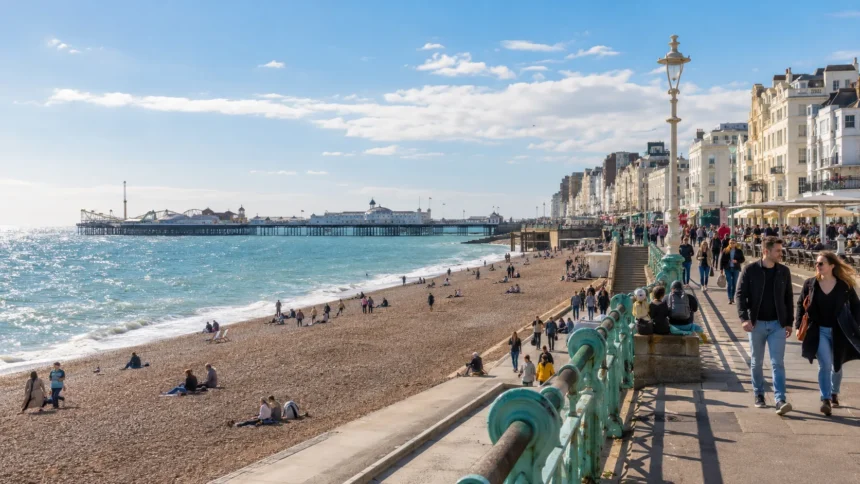
Brighton is in East Sussex, on the south coast of England. More precisely, Brighton is part of the City of Brighton and Hove, a unitary authority located within the ceremonial county of East Sussex and the historic county of Sussex.
That distinction is important because Brighton & Hove City Council operates independently from East Sussex County Council.
Brighton is therefore geographically and ceremonially associated with East Sussex, but most local government services in the city are managed directly by Brighton & Hove City Council.
Brighton and neighbouring Hove were brought together under a single unitary authority in 1997, and Brighton and Hove was formally granted city status in 2001.
For travellers, students, people planning to move to Brighton or anyone simply trying to
What County Is Brighton In the UK?
Brighton is in the ceremonial county of East Sussex.
It lies on England’s south coast, directly facing the English Channel. The South Downs rise immediately behind the city, while Hove lies directly to the west.
There are several different geographic and administrative terms associated with Brighton:
- East Sussex is Brighton’s ceremonial county.
- Sussex is its historic county.
- South East England is its official English region.
- Brighton and Hove is the city and unitary authority.
- Brighton & Hove City Council provides most local government services.
- England is the country in which Brighton is located.
The Office for National Statistics classifies Brighton and Hove as a unitary authority within South East England.
For most everyday purposes, therefore, saying “Brighton, East Sussex” is perfectly acceptable.
The situation becomes slightly more complicated only when discussing local government because Brighton & Hove does not operate under East Sussex County Council.
Is Brighton in Sussex or East Sussex?
Brighton can correctly be described as being in both Sussex and East Sussex, depending on what type of geography is being discussed.
Sussex is the traditional historic county.
East Sussex is one of the modern ceremonial counties associated with the historic Sussex area.
Historic Sussex and modern East Sussex
Historically, Sussex covered a large part of England’s south coast. Its name derives from the South Saxons, and the area has maintained a strong cultural identity for centuries.
Modern administrative and ceremonial arrangements are more complicated than the historic county boundaries.
Today, Sussex is primarily associated with:
- East Sussex
- West Sussex
- Brighton and Hove
- numerous towns, villages and communities that continue to identify strongly with Sussex
Brighton and Hove remains within the ceremonial county of East Sussex, even though the city has its own unitary council.
This is why someone might accurately say either:
- “Brighton is in East Sussex”; or
- “Brighton is in Sussex.”
The first is more precise when answering a modern county question. The second reflects Brighton’s broader historical and cultural identity.
Why Isn’t Brighton Governed by East Sussex County Council?
This is where most of the confusion surrounding Brighton’s county status begins.
Brighton is ceremonially in East Sussex, but Brighton & Hove City Council is a unitary authority.
A unitary authority is a local-government structure in which one council provides most of the services that would otherwise be divided between a county council and a district or borough council.
Brighton & Hove City Council describes itself as the only existing unitary local-government authority in Sussex under the current structure.
That means services such as the following are handled locally:
- Schools and education
- Social care
- Housing
- Libraries
- Waste collection and disposal
- Highways
- Planning
- Licensing
- Public health
In neighbouring two-tier parts of Sussex, these responsibilities may be divided between a county council and a district or borough council.
Ceremonial county vs local authority
The easiest way to understand Brighton’s position is to separate ceremonial geography from council administration.
| Question | Brighton’s position |
| What ceremonial county is Brighton in? | East Sussex |
| What historic county is Brighton in? | Sussex |
| Does East Sussex County Council govern Brighton? | No |
| Who provides Brighton’s council services? | Brighton & Hove City Council |
| Is Brighton & Hove a unitary authority? | Yes |
| Is Brighton in South East England? | Yes |
This is not unique to Brighton. Several English cities and urban areas are geographically associated with wider counties while operating under separate unitary local-government structures.
Has Brighton’s County Status Changed in 2026?
Brighton continues to be part of the ceremonial county of East Sussex, and Brighton & Hove City Council remains the city’s unitary local authority.
There have, however, been discussions about wider local government reorganisation across Sussex.
Proposals have considered changes to the way council services are organised across East Sussex, West Sussex and neighbouring areas.
These discussions should not be confused with Brighton suddenly moving to a different historic or ceremonial county.
As of October 2026, Brighton’s current council structure remains in place. Brighton & Hove City Council’s latest information says previously agreed proposals involving Brighton & Hove and neighbouring communities are currently paused.
For someone simply asking “What county is Brighton in?”, the answer therefore remains East Sussex.
Is Brighton the Same Place as Brighton and Hove?
Not exactly.
Brighton is one part of the larger City of Brighton and Hove.
Brighton and Hove developed historically as neighbouring settlements before their local authorities were eventually combined.
Today, it is possible to travel between central Brighton and central Hove without encountering any obvious break in the built-up area, but the two places maintain distinct histories and local identities.
Brighton
Brighton occupies much of the central and eastern portion of the main urban area.
Some of the locations most closely associated with Brighton include:
- Brighton Palace Pier
- Brighton Beach
- the Royal Pavilion
- The Lanes
- North Laine
- Kemptown
- Brighton Marina
- Brighton railway station
Hove
Hove lies immediately west of Brighton.
It is generally associated with a somewhat more residential character, broad avenues, Regency and Victorian architecture, Hove Lawns and its own seafront.
The modern council area extends well beyond Brighton and central Hove, incorporating numerous suburbs, villages and areas of downland.
When Did Brighton and Hove Join Together?
Brighton and Hove officially became one local-government area on 1 April 1997.
Before that date, Brighton Borough Council and Hove Borough Council existed as separate authorities.
A review of local government led to the creation of the new Brighton and Hove Borough Council, operating as a unitary authority.
Several years later, Brighton and Hove was granted city status.
A useful timeline is:
| Year | Development |
| 1854 | Brighton received a royal charter of incorporation |
| 1889 | Brighton became a county borough |
| 1889 | Hove became a municipal borough |
| 1997 | Brighton and Hove became one unitary authority |
| 2001 | Brighton and Hove formally gained city status |
The city’s modern administrative identity is therefore relatively recent compared with the long histories of Brighton and Hove as individual settlements.
Is Brighton a City or a Town?
Brighton is commonly called a city because it forms the main part of the City of Brighton and Hove.
Historically, Brighton was a town.
The combined Brighton and Hove authority received official city status in 2001, meaning the formal city is technically Brighton and Hove, rather than Brighton by itself.
In everyday conversation, however, people routinely refer to Brighton as a city.
You will therefore commonly encounter descriptions such as:
- Brighton city centre
- Brighton city break
- Brighton city attractions
- Brighton city centre shops
- Brighton city nightlife
These are entirely normal contemporary uses of the name.
Brighton’s popularity also places it among South West Mag’s selection of the best cities to visit in England, alongside destinations including London, Bath, Bristol, Oxford and York.
Where Exactly Is Brighton Located?
Brighton lies on the south coast of England, around 50 miles south of central London.
It faces the English Channel and occupies a narrow urban area between the coastline and the South Downs.
Its approximate geographic position is around 50.8° north and 0.1° west.
Brighton’s surroundings can be broadly understood as follows:
| Direction from Brighton | Main feature or place |
| North | South Downs |
| South | English Channel |
| West | Hove and Portslade |
| East | Kemptown, Roedean, Ovingdean and Rottingdean |
| North-east | Lewes and surrounding East Sussex countryside |
| North-west | West Sussex and the wider Sussex countryside |
The physical geography has strongly influenced Brighton’s shape.
Unlike cities that have expanded equally in every direction, Brighton is squeezed between the sea and the Downs. Much of its urban expansion has consequently taken place east and west along the coast and northwards through valleys in the chalk hills.
Is Brighton in South East England?
Yes. Brighton is in South East England.
It is not part of South West England.
South East England is one of England’s official regions and includes areas such as:
- East Sussex
- West Sussex
- Kent
- Surrey
- Hampshire
- Berkshire
- Oxfordshire
- Buckinghamshire
- the Isle of Wight
Brighton sits near the southern edge of this region.
The Office for National Statistics officially places Brighton and Hove in South East England.
This means Brighton is geographically separate from the traditional South West counties such as Cornwall, Devon, Somerset and Gloucestershire.
How Far Is Brighton From London?
Brighton is approximately 50 miles south of central London, although the exact road distance varies depending on the starting point and route.
One of Brighton’s biggest advantages is its transport connection with the capital.
Direct trains operate between Brighton and major London stations, and some journeys take around an hour.
This accessibility has made Brighton popular with:
- Day-trippers
- Weekend visitors
- Commuters
- Students
- International tourists staying in London
- London residents looking for a coastal break
Brighton consequently appears in South West Mag’s guide to the best day trips from London by train.
It is also included among the wider selection of day trips from London, particularly because visitors can reach the beach, central attractions and shopping areas without requiring a car.
Is Brighton part of London?
No.
Brighton is completely separate from London.
London is its own English region, while Brighton lies in South East England within the ceremonial county of East Sussex.
Brighton has its own:
- Local council
- Railway station
- Postcode districts
- Local economy
- Universities
- Communities
- City centre
- Tourism industry
Its strong transport relationship with London does not make Brighton a London suburb.
Which Places Are Close to Brighton?
Brighton’s central position on the Sussex coast places it close to several popular towns, villages and coastal destinations.
| Place | Direction from Brighton | Why it is known |
| Hove | West | Seafront, architecture and residential areas |
| Lewes | North-east | Historic county town, castle and South Downs setting |
| Rottingdean | East | Historic village and coastline |
| Shoreham-by-Sea | West | Harbour and coastal community |
| Worthing | West | Large West Sussex seaside town |
| Newhaven | East | Harbour and ferry port |
| Seaford | East | Coastal town near the Seven Sisters |
| Eastbourne | East | Major East Sussex seaside resort |
| Peacehaven | East | Coastal town between Brighton and Newhaven |
This makes Brighton a practical base for exploring more of Sussex rather than treating it solely as a standalone weekend destination.
What Areas Make Up Brighton and Hove?
The City of Brighton and Hove covers around 83 square kilometres, and its boundaries contain far more than central Brighton and Hove.
The authority contains urban neighbourhoods, historic villages, residential suburbs, coastal communities and areas of open downland.
Notable districts and communities include:
- Brighton
- Hove
- Portslade
- Mile Oak
- Aldrington
- Hangleton
- West Blatchington
- Westdene
- Withdean
- Patcham
- Hollingbury
- Hollingdean
- Coldean
- Moulsecoomb
- Bevendean
- Kemptown
- Whitehawk
- Roedean
- Woodingdean
- Ovingdean
- Rottingdean
Central Brighton
Central Brighton is the area most visitors encounter first.
It contains major attractions, retail streets and entertainment areas such as:
- the Royal Pavilion
- Brighton Palace Pier
- Brighton Beach
- North Laine
- The Lanes
- Churchill Square
- Brighton railway station
- the seafront
This is also where Brighton’s dense urban character is most apparent.
Eastern Brighton
Travel east from the centre and Brighton gradually passes through Kemptown, Whitehawk and Roedean before reaching Ovingdean and Rottingdean.
The landscape becomes progressively less urban as the city approaches the chalk cliffs and open countryside.
Northern Brighton
North Brighton contains districts such as Patcham, Hollingbury, Coldean, Moulsecoomb and Bevendean.
These neighbourhoods climb towards or sit within the South Downs landscape.
Western Brighton and Hove
To the west, Brighton merges seamlessly into Hove.
Continue farther and the urban area eventually reaches Portslade and the boundary with West Sussex.
How Did Brighton Grow From a Fishing Settlement Into a City?
Brighton’s transformation is one of the most interesting urban stories on England’s south coast.
The settlement was historically known as Brighthelmstone and for centuries was strongly associated with fishing and maritime activity.
Its fortunes changed substantially during the 18th century.
At the time, sea bathing became fashionable among wealthy British society. Seawater and coastal air were promoted as beneficial to health, helping seaside towns attract visitors who might previously have spent their leisure time at inland spa resorts.
Brighton’s proximity to London gave it a major advantage.
Its development accelerated as wealthier visitors arrived, new accommodation was constructed and the town’s reputation spread.
Royal involvement then transformed Brighton even further.
What Role Did George IV Play in Brighton’s Development?
George, Prince of Wales, who later became King George IV, became closely associated with Brighton during the late 18th and early 19th centuries.
His visits helped establish Brighton as one of Britain’s fashionable seaside resorts.
The strongest surviving symbol of his connection with the city is the Royal Pavilion.
Initially based around a more modest residence, the property was progressively transformed into the spectacular palace seen today.
Architect John Nash oversaw a major redevelopment during the early 19th century.
The resulting building became famous for features including:
- Domes
- Minarets
- Elaborate interiors
- Indian-inspired exterior architecture
- Chinese-influenced interior decoration
The Pavilion remains one of Brighton’s most recognisable landmarks.
Royal patronage attracted fashionable society, encouraged construction and helped change Brighton from a relatively modest coastal settlement into a major resort.
How Did the Railway Change Brighton?
The railway was another turning point.
Brighton’s railway connection with London opened during the 19th century and dramatically reduced the difficulty and cost of travelling between the capital and the coast.
This helped transform Brighton from a resort largely associated with wealthy visitors into a destination accessible to a much broader population.
As visitor numbers grew, so did:
- Hotels
- Guesthouses
- Entertainment venues
- Restaurants
- Shops
- Piers
- Residential development
- Public transport
Brighton increasingly developed the classic characteristics associated with Victorian seaside tourism.
Rail connections remain crucial today.
Brighton station continues to provide direct services towards London and other destinations across southern England.
How Did Brighton’s Boundaries Expand?
The Brighton known today is considerably larger than the historic settlement.
As its population increased, development spread into neighbouring areas.
Several boundary extensions helped create the modern urban area.
Among the important changes were the incorporation or development of places including:
- Patcham
- Ovingdean
- Rottingdean
- parts of Falmer
- Woodingdean
- Coldean
- Stanmer
- Bevendean
- Moulsecoomb
The development of Brighton Marina also extended the city’s built environment eastwards along the coast.
Meanwhile, Hove expanded through Aldrington, Hangleton, West Blatchington and eventually towards Portslade.
The joining of Brighton and Hove in 1997 therefore brought together two already substantial neighbouring urban areas.
What Is Brighton Famous For Today?
Brighton is now one of Britain’s best-known seaside destinations.
Its appeal extends considerably beyond the traditional British seaside holiday.
The city is associated with:
- Brighton Palace Pier
- the Royal Pavilion
- Brighton Beach
- The Lanes
- North Laine
- Regency architecture
- Independent shops
- Restaurants and cafés
- Nightlife
- Music
- Festivals
- Street art
- LGBTQ+ culture
- Universities
- The creative industries
- Brighton & Hove Albion Football Club
- The South Downs
Visitors wanting a broader itinerary can explore South West Mag’s guide to the best things to do in Brighton.
Why Is Brighton Palace Pier So Famous?
Brighton Palace Pier is one of the city’s defining landmarks.
Opened during the Victorian era, it extends from the seafront into the English Channel and remains closely associated with traditional British seaside entertainment.
Visitors can expect a combination of:
- Amusement rides
- Arcade games
- Food stalls
- Sea views
- Entertainment
- Traditional seaside atmosphere
Its position close to central Brighton means it can easily be combined with the Royal Pavilion, The Lanes and Brighton Beach during a one-day visit.
The pier is particularly recognisable when viewed from the beach and has become one of the most photographed locations in Brighton.
What Is Special About Brighton Beach?
Brighton Beach is one of Britain’s most famous urban beaches.
Unlike the sandy beaches found in many other coastal destinations, Brighton’s shoreline is predominantly shingle and pebbles.
The beach stretches along the city and provides easy access to:
- Cafés
- Bars
- Restaurants
- Entertainment
- water sports
- The pier
- Hove Lawns
- The promenade
Brighton’s beach culture is particularly busy during warmer months, although the seafront remains active throughout much of the year.
Even outside summer, visitors come to Brighton for coastal walks, restaurants, events and views over the English Channel.
What Is the Difference Between The Lanes and North Laine?
Visitors regularly confuse these two areas because of their similar names.
They are, however, distinct parts of Brighton.
| Area | Character |
| The Lanes | Historic narrow streets, jewellery shops, boutiques and restaurants |
| North Laine | Independent shops, cafés, vintage stores, street art and creative businesses |
The Lanes occupy part of Brighton’s historic centre and preserve the narrow street pattern associated with the older settlement.
North Laine, situated farther north, has become strongly associated with independent retail and Brighton’s alternative character.
Both can easily be explored on foot from Brighton station, the Royal Pavilion or the seafront.
Is Brighton Close to the South Downs?
Yes.
One of Brighton’s most distinctive features is its immediate proximity to the South Downs.
The hills rise behind the city and create a dramatic contrast with the dense urban coastline.
The South Downs landscape includes:
- Chalk hills
- Grassland
- Walking trails
- Viewpoints
- Farmland
- Historic villages
- Wildlife habitats
This means visitors can experience a busy coastal city and open countryside during the same trip.
Places such as Devil’s Dyke provide some of the best-known countryside excursions from Brighton.
Is the South Downs National Park Actually Inside Brighton?
Parts of the wider landscape surrounding Brighton connect directly with the South Downs National Park, and significant areas of downland lie within or immediately beside the city’s administrative boundary.
This relationship affects Brighton in ways that are not immediately obvious to visitors staying near the beach.
Despite being a densely developed city, Brighton & Hove contains substantial green space and downland.
Stanmer Park and the surrounding countryside are particularly important examples.
For walkers and cyclists, Brighton can therefore serve as an urban gateway into the South Downs.
Is Brighton Worth Visiting?
For visitors interested in city breaks, coastal destinations or day trips from London, Brighton offers an unusually broad range of experiences within a compact area.
A single day can include:
- Walking along Brighton Beach
- Visiting Brighton Palace Pier
- Exploring the Royal Pavilion
- Shopping in The Lanes
- Browsing independent businesses in North Laine
- Eating beside the sea
- Exploring Brighton’s nightlife
With additional time, visitors can explore the South Downs or make short trips elsewhere in Sussex.
Brighton also works well as part of a wider journey through the best places to go in England because of its direct rail connections and concentration of attractions.
Is Brighton Good for a Day Trip From London?
Yes. Brighton is one of the most practical coastal day trips from London.
Its main advantage is that most of the attractions visitors want to see are within walking distance of Brighton railway station.
A straightforward day-trip route might be:
- Arrive at Brighton railway station.
- Walk through North Laine.
- Visit the Royal Pavilion.
- Explore The Lanes.
- Continue to Brighton Palace Pier.
- Walk along Brighton Beach.
- Have dinner in central Brighton.
- Return to the station for the train to London.
People wanting a quieter trip could replace some of the central attractions with Hove, Rottingdean or the South Downs.
What Is East Sussex Known For Beyond Brighton?
Brighton is only one part of the wider East Sussex area.
The county contains an extensive mixture of coastline, historic towns, countryside and nationally significant landmarks.
Important destinations include:
Lewes
Lewes lies a short distance north-east of Brighton.
It is the traditional county town of East Sussex and is known for its historic streets, castle and dramatic setting within the South Downs.
Its atmosphere is significantly different from Brighton, making the two places easy to combine on the same trip.
Eastbourne
Eastbourne is another major East Sussex seaside destination.
It lies farther east along the coast and is particularly associated with its seafront, pier, Victorian architecture and proximity to Beachy Head.
Seven Sisters
The Seven Sisters are among the most recognisable chalk cliffs in southern England.
Their white cliffs and rolling downland create some of the county’s most dramatic coastal scenery.
Hastings
Hastings is famous for its relationship with the events surrounding the Norman Conquest of 1066, although the Battle of Hastings itself took place inland near the modern town of Battle.
Today’s Hastings combines a historic Old Town, fishing traditions, seafront and cultural attractions.
Rye
Rye is a smaller historic town in the eastern part of East Sussex.
Its cobbled streets, old buildings and medieval character make it markedly different from Brighton’s larger and more energetic city environment.
How Is Brighton Different From Other East Sussex Seaside Towns?
Brighton is considerably larger and more urban than many neighbouring coastal destinations.
It combines the characteristics of a seaside resort with those of a major regional city.
| Destination | General character |
| Brighton | Large, lively seaside city with nightlife, shopping and culture |
| Eastbourne | Traditional resort with access to Beachy Head |
| Seaford | Smaller coastal town close to the Seven Sisters |
| Hastings | Historic seaside town with fishing heritage |
| Bexhill-on-Sea | Quieter seaside resort with cultural attractions |
| Rye | Historic inland/coastal-edge town with medieval character |
Brighton consequently appeals to visitors seeking considerably more than a beach holiday.
What Is Brighton’s Population?
Population figures can vary depending on whether someone is referring to Brighton itself, the Brighton and Hove local-authority area or the wider urban area.
This distinction is important.
The City of Brighton and Hove had around 284,000 residents in recent official estimates, while the continuous wider urban area extends beyond the council boundary and contains considerably more people.
When comparing population figures online, always check whether the source refers to:
- Brighton as a settlement
- Brighton and Hove local authority
- the Brighton/Worthing/Littlehampton built-up area
- A wider metropolitan or travel-to-work area
These geographic definitions can produce significantly different numbers.
FAQs
What county is Brighton in?
Brighton is in the ceremonial county of East Sussex and the historic county of Sussex.
Is Brighton governed by East Sussex County Council?
No. Brighton is administered by Brighton & Hove City Council, which operates as a unitary authority.
Is Brighton in South East England?
Yes. Brighton is officially located in South East England, on the English Channel coast.
Are Brighton and Hove the same place?
They are neighbouring areas that form the City of Brighton and Hove, although Brighton and Hove retain distinct local identities.
When did Brighton and Hove become a city?
Brighton and Hove was granted official city status in 2001, several years after the two councils were merged in 1997.
Is Brighton close to London?
Yes. Brighton is around 50 miles south of central London and is connected by direct rail services.
What is Brighton best known for?
Brighton is known for its beach, Palace Pier, Royal Pavilion, The Lanes, nightlife and access to the South Downs.