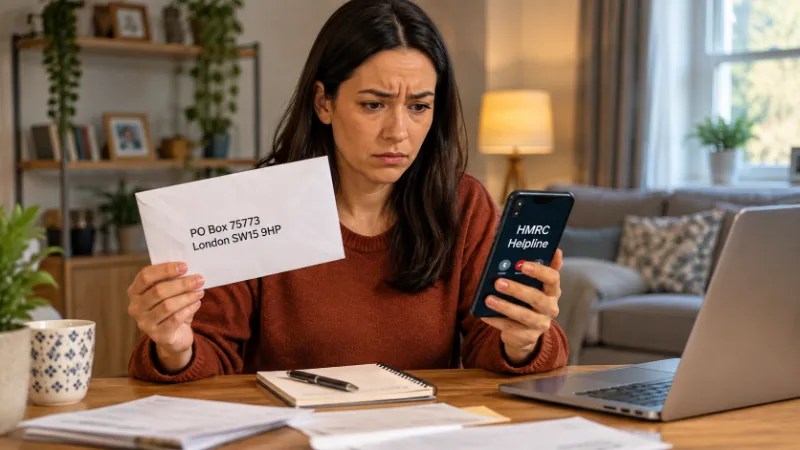
Receiving an unexpected letter showing PO Box 75773 London SW15 9HP can immediately raise questions about who sent it and whether it is genuine.
The address has been widely reported online in connection with HM Revenue & Customs correspondence, although recipients should not assume that the PO Box alone proves a particular letter came from HMRC.
A PO Box is simply a postal address used to process mail rather than a normal public-facing office. Large organisations and government departments commonly use centralised postal facilities because they handle substantial volumes of correspondence.
Anyone who receives a letter displaying PO Box 75773 should therefore focus primarily on what the letter says, which department it claims to come from, what action it requests and whether those details can be independently verified.
Readers unfamiliar with this type of postal arrangement may also find it useful to understand how another UK PO Box address can function as part of a large-scale mail-handling system.
Who Is Behind PO Box 75773 London?
PO Box 75773 London has commonly been associated online with HMRC-related correspondence. However, there does not appear to be a current GOV.UK page explicitly confirming that every piece of mail displaying this exact PO Box originates from HMRC.
That distinction matters.
A recipient should avoid treating the return address by itself as proof that the communication is genuine. Instead, check the organisation named inside the letter and independently verify any important request.
HMRC regularly communicates by post about matters including Income Tax, Self Assessment, National Insurance, Corporation Tax, Child Benefit and other areas it administers.
In September 2026, HMRC’s official genuine-letter guidance includes examples involving Self Assessment repayments, National Insurance refunds and Corporation Tax matters.
The safest conclusion is therefore that PO Box 75773 has been reported in connection with HMRC correspondence, but the individual letter should still be verified on its own merits.
What Does the SW15 9HP Postcode Mean?
The postcode SW15 9HP forms part of the address commonly shown alongside PO Box 75773 London.
Unlike a normal street address, a PO Box does not necessarily identify an office that members of the public can visit. PO Boxes are designed primarily for postal processing and may be used to centralise incoming or outgoing correspondence.
This is important because someone searching SW15 9HP may expect to find a recognisable HMRC building at the location. That is not how a PO Box normally works.
Seeing a postcode attached to the PO Box also does not prove who created a particular letter. A fraudulent document can reproduce a genuine-looking address, so verification should always extend beyond the postcode.
Why Might You Receive a Letter From PO Box 75773 London?
There are many possible reasons why someone could receive HMRC-related correspondence unexpectedly.
The subject of the letter could concern:
- Income Tax changes or calculations
- Self Assessment returns or repayments
- PAYE information
- National Insurance contributions
- Child Benefit matters
- Corporation Tax for businesses
- Tax Refunds or repayment checks
- Outstanding Tax or payment reminders
- Information Requests linked to HMRC records
- Compliance Checks where additional evidence is required
HMRC sometimes contacts people because information on its records needs to be checked rather than because the recipient has done something wrong.
For example, current HMRC guidance confirms that some people may receive letters relating to excessive National Insurance contributions, Self Assessment repayment verification or discrepancies involving Corporation Tax returns.
Families dealing with HMRC correspondence about Child Benefit can also check their payment history and relevant documentation.
Understanding details such as when Child Benefit normally reaches a bank account can help when comparing a letter with existing records.
Receiving an unexpected letter is therefore a reason to check the communication, not automatically a reason to assume there is a tax problem.
Is PO Box 75773 London Legitimate?
The PO Box has been widely reported as being connected with official-looking correspondence, but the more important question is whether the specific letter received is genuine.
A legitimate postal address can potentially be copied onto a fraudulent document. The same applies to logos, department names, reference formats and official-looking wording.
Someone checking the letter should look for information that can be independently confirmed, such as:
- The HMRC Department named in the letter
- The Tax Or Benefit Matter being discussed
- The Tax Year involved
- A Relevant Reference Number
- Information Matching Existing Records
- Clear Instructions about why HMRC is making contact
If anything seems unusual, contact the relevant HMRC team using details obtained independently from GOV.UK rather than relying solely on a telephone number or web address printed in an unexpected letter.
HMRC specifically advises people who receive a suspicious letter to contact the HMRC team the communication claims to come from.
How Can You Check Whether the Letter Is Really From HMRC?
One of the strongest ways to verify an unexpected letter is to compare it with information published directly by HMRC.
HMRC maintains an official list of recent genuine letters. As of September 2026, the page includes examples covering several different tax and National Insurance matters.
When checking a letter:
- Read The Whole Letter Carefully: Identify what HMRC supposedly wants and why.
- Check the Tax or Benefit Matter: Consider whether it relates to something already connected with you.
- Compare Your Records: Check your HMRC account, previous correspondence and relevant financial records.
- Search Official HMRC Guidance: Look for the type of communication on GOV.UK.
- Verify Contact Details Independently: Do not rely exclusively on telephone numbers or links in unexpected correspondence.
- Contact the Relevant HMRC Team: Ask whether the communication is genuine if uncertainty remains.
For Child Benefit correspondence, having the correct reference can also make verification easier. Those who cannot locate theirs can check how to find a Child Benefit number before contacting the relevant service.
What If Your Letter Is Not Listed on GOV.UK?
Not finding your letter on HMRC’s genuine-contacts list does not automatically mean it is fraudulent.
HMRC specifically states that not every communication it sends is included in its published lists.
The list is therefore a useful checking tool rather than a complete record of every HMRC letter currently circulating.
If the communication is not listed:
- Do Not Assume It Is Fake
- Do Not Assume It Is Genuine
- Check Your HMRC Account Where Relevant
- Contact The Department Independently
- Avoid Sending Sensitive Information Until Verified
This approach is particularly important if the letter demands payment, asks for bank details or requests identity documents.
What If the Letter Contains a QR Code?
A QR code does not automatically make an HMRC letter suspicious.
HMRC confirms that it uses QR codes in a range of genuine letters and maintains a separate list showing recognised communications containing them.
Examples include P2 tax code notices, Self Assessment letters, VAT communications, National Insurance notifications and some Child Benefit correspondence.
However, recipients should still be cautious.
HMRC says QR codes included in its correspondence will usually lead to information on GOV.UK. Its scam guidance also says legitimate HMRC QR codes will not unexpectedly take users to a page requiring personal information.
Before scanning an unexpected code:
- Identify The Letter Type
- Check It Against HMRC Guidance
- Avoid Entering Personal Details On An Unverified Page
- Do Not Provide Banking Information Simply Because A QR Code Requests It
If in doubt, navigate to GOV.UK independently instead of using the code.
Can Scammers Copy a Genuine PO Box Address?
Yes. The presence of a real postal address is not enough to establish that a letter is genuine.
Fraudsters can reproduce information already available publicly or copy details from authentic correspondence.
This can include:
- Government Department Names
- Postal Addresses
- Logos
- Official-Looking Formatting
- Telephone Numbers
- Reference-Style Numbers
- Tax Terminology
This is why judging a letter purely by its appearance is risky.
HMRC advises people to be particularly cautious about communications that create urgency, make threats, unexpectedly request personal details, demand money transfers or promise refunds and rebates.
Rather than asking only, “Is this PO Box real?”, the better question is:
“Can I independently confirm that HMRC genuinely sent this particular letter?”
Could an Unexpected Letter Be Linked to Identity Fraud?
Most unexpected HMRC letters will not mean someone has stolen your identity. However, unfamiliar correspondence can sometimes indicate that records have been changed or activity has occurred without your knowledge.
HMRC lists unexpected letters or payments among the potential signs of suspicious activity affecting an HMRC online account.
Other indicators include unexplained tax-record changes and receiving access codes when you have not attempted to sign in.
Possible warning signs include:
- Tax Records you do not recognise
- Employment Details relating to an employer you never worked for
- Unexpected Refunds or repayment claims
- Changes To Personal Details you did not make
- Security Codes arriving when you have not logged in
- HMRC Letters about activity you know nothing about
If several of these signs appear together, checking the HMRC account promptly is sensible.
HMRC advises people who believe someone has accessed their online account without permission to report the activity immediately and change their password if they can still access the account.
What Should You Do If the Letter Is Addressed to Someone Else?
A PO Box 75773 letter may occasionally arrive for someone who does not live at your address.
The person named could be:
- A Previous Tenant
- A Previous Property Owner
- Someone Who Entered Their Address Incorrectly
- A Person Unknown To The Household
- Someone Whose Records Have Not Been Updated
Do not assume that the letter relates to you simply because it arrived at your property.
Mail addressed to someone else should normally be returned appropriately rather than opened and treated as your correspondence.
If repeated government letters continue arriving for an unknown person, the situation may need to be raised with the relevant organisation so its records can be reviewed.
Repeated unexplained correspondence can deserve closer attention if the names, tax matters or personal details appear connected to suspected identity misuse.
Should You Reply Directly to PO Box 75773 London?
Not necessarily.
The return address printed on an envelope is not always the address that should be used when responding. Different HMRC services have different postal addresses and response procedures.
If a genuine letter requires a reply, use the instructions relating specifically to the matter being handled.
Before sending documents:
- Check The Required Response Method
- Confirm The Correct Postal Address
- Check Whether An Online Service Is Available
- Keep Copies Of Important Documents
- Include The Correct Reference Where Requested
Do not automatically send passports, bank statements, identity documents or other sensitive information to an address simply because it appears on an envelope.
HMRC also operates online services for submitting certain forms of evidence when it specifically asks taxpayers to do so.
What Should You Check Before Making a Payment?
A demand for money deserves particular attention.
Do not make a payment solely because a letter looks official or contains a government-style postal address.
Before paying:
- Check What Tax Is Allegedly Owed
- Confirm The Relevant Tax Year
- Compare The Amount With Your Records
- Check The Payment Reference
- Verify The Payment Method Through GOV.UK
- Contact HMRC If The Amount Cannot Be Explained
Be especially cautious when a letter asks for payment through an unusual method or directs money somewhere that cannot be independently linked to HMRC.
Current HMRC scam guidance identifies pressure, threats, unexpected requests for financial information and instructions to transfer money as warning signs worth checking.
A genuine tax liability should be dealt with promptly, but taking time to independently confirm where the demand came from can prevent an expensive mistake.
What Should You Do If Letters Keep Arriving?
Repeated correspondence does not necessarily mean something serious is happening.
Several letters may be sent because:
- A Previous Letter Was Not Answered
- HMRC Requires Additional Information
- Records Have Not Yet Been Updated
- A Tax Or Benefit Issue Remains Open
- Different Departments Are Contacting You
- The Intended Recipient No Longer Lives At The Address
Do not simply ignore repeated letters.
Read each one and check whether it relates to the same matter. If the correspondence appears genuine and requires action, following the requested process may stop further reminders.
If repeated letters are for another person, avoid responding as though you are that individual. Where appropriate, return the correspondence and notify the organisation through its official channels.
Conclusion
PO Box 75773 London SW15 9HP has generated interest because people often see the address without immediately knowing which organisation is behind the correspondence.
The address has been widely reported in connection with HMRC-related mail, but recipients should not treat the PO Box itself as definitive proof that an individual letter is genuine.
What matters most is whether the subject, references, contact details and requested action can be independently verified.
HMRC now provides dedicated guidance covering recent genuine letters, communications using several contact methods and letters containing QR codes.
These resources give recipients much stronger ways to assess unexpected correspondence than simply judging its logo, spelling or postal address.
If a PO Box 75773 letter requests money, personal information or important documents, verify it through official HMRC channels before responding. If it proves genuine, follow the relevant instructions and deadlines rather than ignoring it.
FAQs
Is PO Box 75773 London an HMRC Address?
PO Box 75773 London has been widely reported in association with HMRC-related correspondence. However, recipients should verify their individual letter through official HMRC channels rather than relying on the PO Box alone.
Is PO Box 75773 London a Scam?
The appearance of the address does not by itself mean a letter is a scam. Equally, a genuine-looking address can be copied, so the contents and requested action should be independently checked.
Why Have I Received a Letter From PO Box 75773?
Possible reasons include tax calculations, Self Assessment matters, National Insurance records, benefit administration, repayment verification, outstanding tax or requests for further information.
What Does SW15 9HP Mean?
SW15 9HP is the postcode commonly shown with PO Box 75773 London. A PO Box postcode is primarily part of the postal handling system and should not be treated as proof of the sender’s identity.
Can I Ignore a Letter From PO Box 75773?
It is better to verify the letter first. If it is genuine and requires action, ignoring it could delay a repayment, leave records incorrect or allow a tax issue to remain unresolved.
How Can I Verify an HMRC Letter?
Check HMRC’s current genuine-contact guidance, compare the letter with your records and contact the relevant HMRC department using independently obtained GOV.UK contact details.
Should I Send Documents Back to PO Box 75773?
Only send documents using the response method specifically confirmed for your case. Do not assume that the return address printed on the envelope is automatically the correct destination for sensitive documents.